

The fraternal and sororal organization at my place of work wrapped up new member initiations this past week. I assume pledging hasn’t changed much since I was in college: namely, that the week leading up to “the crossing” is often referred to as Hell Week by the initiates. This week was, for me, a hell week of sorts: the first of many between now and graduation. I thought it might be helpful to document my daily activities for the benefit of you, dear reader, should you happen to be a new or aspiring academic librarian. This is how we do.
As an aside: It also gave me some much needed motivation to make it through the week.
While this particular week was busier than most, it was not uncharacteristic, and it perfectly exemplified the variety of tasks some academic librarians undertake (see also: “other duties as assigned”). Let me start by providing some context: I work at a small (FTE=1700), 4-year liberal arts college. Librarians at my institution do not have tenure (though, we do have faculty voting rights). Instead, we have a promotion track and are expected to devote part of our time to service and professional development. All librarians (all 5.5 of us) are expected to liaison with multiple departments and develop collections in those areas. In addition to supervising students, I also supervise two employees, one full-time and one part-time.
UPDATE: It may go without saying, but this is just one academic librarian’s experience. In particular, it’s the experience of a Reference & Instruction Librarian. And let’s be honest with ourselves: it’s the experience of a somewhat workaholic-prone academic librarian at a small library where everyone does a little bit of everything. Caveat lector.
Monday
4:45 am – Research project and reading: My mornings begin early. As this is often the only time I have uninterrupted, it’s time that I dedicate to working on my IRDL research project as well as keeping up with new writing in the field. (Actually, my work week begins Sunday evening when I usually spend 2-3 hours catching up on emails I’ve put off from the week before and going through my to dos for the next week.)
9:00 am – Instruction Lab redesign meeting: We are lucky this year in that we have some additional funds to renovate the library’s Instruction Lab. So my work week began with a quick brainstorming meeting with colleagues to discuss plans, vendors, technology, furniture, and room configuration.

10:00 am – Info Desk: Quick hour at the reference desk (which I mostly spent planning for my 11am meeting).
11:00 am – ALA WAC meeting: This year, I am chair of ALA’s Website Advisory Meeting. We have bi-monthly meetings in between ALA conferences. Today we met briefly to discuss the ongoing work of the subcommittees, including developing a welcome page for ALA Connect users and reviewing ALA’s style guide.

12:00 – 3:00 pm – Various tasks: It’s rare that I have so much open time during the day, so these moments are usually spent working on a flurry of smaller tasks. For example, in these three hours I:
- ate a quick lunch
- ordered books for our Wikipedia event on Thursday
- processed a few interlibrary loan requests
- put some final touches on the article I’m co-writing
- prepared material for the two INTD 35 classes I’m teaching on Tuesday and Wednesday
- scheduled a workshop for the end of March and followed up on other instruction requests
- processed the new Ishiguro novel for our McNaughton collection (and showed it around the office)
- started one of my student workers on an assessment project (processing feedback from Fall freshmen writing seminars)
3:00 pm – DigLibArts meeting: I am the librarian representative for our Digital Liberal Arts Program’s steering committee. We meet as needed throughout the year. Today, we discussed our upcoming call for funding requests, how to better communicate our message to the faculty, and plans for summer workshops.
4:00 – 6:00pm – Various tasks: Technically, my work days end at 4:00, but since I came in later than usual, I stuck around for an additional two hours. Part of this time was spent replacing all the Academic OneFile links in our LibGuides with an updated URL. The other part was spent researching Wikipedia editing practices in preparation for my next event. I also managed to grab a quick bite to eat. This, by the way, is what more often than not passes for a meal in my day-to-day:

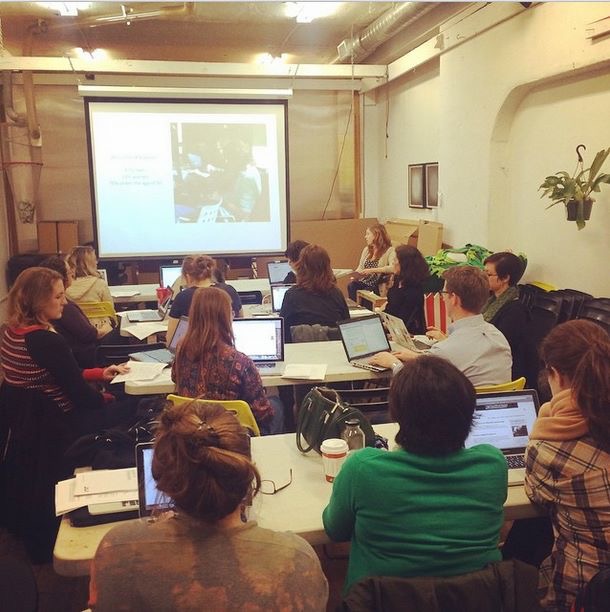
7:00 – 9:00pm – Wikipedia training: Due to fact that I usually pick my daughter up from daycare in the afternoon and have primary caregiver duties in the evening, I don’t usually have the opportunity to attend events after work. Today was a unique experience. In preparation for our Wikipedia Edit-a-thon on Thursday, I along with one of my colleagues attended a train the trainer event at the Machine Project in Echo Park.
Tuesday
8:00 am – Email processing, blogging, and meeting prep: After editing and posting to the library blog, I cleaned out my new messages folder and worked on an agenda for my ACRL Battledecks planning meeting later that afternoon.
9:00 – 10:30 am – Instruction planning: I’m teaching a library instruction workshop for a new class (new for me) this week: a 300-level course called “Economics of politics.” I worked out the following student learning objectives and developed activities around each one:
- Students will learn strategies for “reading” an abstract
- Students will use course knowledge and metadata to create effective keywords for searching
- Students will use citation counts and journal rankings to compare journal within the field; and
- Students will learn how to find full-text articles using a known citation.
More details on Thursday (below).
11:00 am – ALA WAC meeting: A brief phone call with the ALA staff liaisons to the Website Advisory Comittee to discuss upcoming projects.
12:00 – 1:00 pm – Various tasks: I had a lovely conversation with a student about copyright and copyleft. After this, I worked on updating my job description in preparation for annual reviews. During this, a faculty member stopped in my office to briefly tell me that his student papers were “dramatically improved” following my workshop (that’s the kind of thing that makes this all worth while).
1:00 – 1:30 pm – ACRL Battledecks meeting: Met with my subcommittee colleagues in Google Hangouts to discuss our final to-dos for ACRL Battledecks.
1:30 – 2:30 pm – Various tasks: After a late lunch, I dropped by the business office to pick up a reimbursement check (hooray!), processed a few interlibrary loan requests, and mentally prepped for my afternoon class.
2:30 – 4:30 pm – Student mentor workshop: INTD 35 is a class for students who want to become peer mentors. Most of these students eventually work for the tutoring center, for writing center, as student mentors in the freshmen writing seminars, or for me (as Info Desk workers). I teach two workshops for this class, the first of which is about threshold concepts and student barriers to research.
http://www.slideshare.net/johnxlibris/presentation-for-peer-mentors-wc
8:00 – 10:00 pm – Evening labor: Not infrequently, I spend the evening hours after my daughter goes to bed tying up loose ends, responding to emails, and preparing for any classes I have the next day.
Wednesday
8:00 – 9:00 am – ACRL Innovations Cmte: I tied up some of the loose ends for Battledecks, including ordering tshirts for all the participants. I also scheduled some more tweets for the ACRL 2015 mascot @acrlbigfoot (there’s a whole group working on these!).
9:00 – 12:00 pm – Info Desk: It was a fairly slow morning and my 11 am appointment didn’t show, so I spent most of the time at the reference desk preparing materials for my ECON workshop tomorrow. I’m giving each of them the first page of an academic article and asking them to answer a series of questions about the article using only the abstract. So I needed to find a few articles relevant to the course material.
12:00 – 12:30 pm – Lunch: A quick lunch during which I read up on the closing of Sweet Briar College.
12:30 – 2:30 pm – Info Desk: Back at the Info Desk, during which time I was interviewed by the student newspaper about #thedress poll that we put up in the library last week. Continuing to work on my materials for the ECON workshop.
2:30 – 4:30 pm – Student mentor workshop: The very same one I did yesterday, but for a different section of the class.
8:00 pm – 12:30 am – Evening labor: Now that I managed to finish preparing the materials for the ECON class, I needed to start working on the materials for the English class and the high school student class on Friday. Again, both classes that I’ve never taught for before so additional prep was needed.
Thursday
11:30 am – Arrive at work: Each librarian works one late shift during the week to ensure that we have coverage until 10 pm. Thursdays are my late evenings. Technically, I don’t have to report into work until 2p, but I have a standing committee meeting at 12:30.
12:30 – 1:30 pm – WSP meeting: I am currently serving the first year of a three-year commitment to the Whittier Scholars Program Council. The WSP is a program that allows students to design their own curriculum under the supervision of an advisor and the WSP director. The Council is made up of faculty from across the institution.
1:30 – 3:00 pm – ECON 325 class: This was my first time teaching an instruction session for an Economics course. As detailed above, we discussed how to read an abstract, what questions you can ask in order to get at the “meat” of an article, how to interpret metadata, and how to determine a journal’s credibility within its field.
3:00 – 4:00 pm – Librarian meeting: Once a month, the librarians meet. I was late getting to the meeting due to my class, but once there we discussed streaming media, upcoming events, and new database trials.
4:00 – 8:00 pm – Wikipedia Edit-a-thon: In collaboration with our DigLibArts Center, we hosted a “Women in Culture and History” Wikipedia edit-a-thon to coincide with the 70+ other similar events happening around the world this weekend. We had a decently small turnout and only managed to create a few new articles, but did do some substantial editing on pre-existing ones.

8:00 – 10:00 pm – Info Desk: I spent the last couple hours at work at the reference desk preparing for the two classes I will be teaching on Friday.
11:00 – 1:00 am – Various tasks: I finished typing up the handout for tomorrow’s first instruction session and brainstormed some ideas for the ACRL panel planning meeting I have tomorrow afternoon.
Friday
8:00 – 11:00 am – Info Desk: By this point, I’m completely running on coffee and the adrenaline surging through my system due to the nervousness of teaching two new workshops on the same day. While at the reference desk, I printed out all the materials for those two classes, processed a few interlibrary loan requests, and posted to the library’s blog.
10:00 – 11:30 am – Presentation for Amy Biehl students: I’m not sure I’ve ever been more nervous than on Friday when I had to present to a group of (extremely motivated and high-achieving) high school students. I talked to them about how to level up their Google searches, what to look for when evaluating a web site (they actually came up with their own criteria), and why research can be so much more difficult than regular searching (something I usually talk to first-years about). As far as I can tell, it went incredibly well.
12:00 – 1:00 pm – ACRL panel planning: A brief but highly productive virtual meeting with my co-presenters to lay out our talking points for a panel at ACRL 2015. The panel is entitled, “Leading Sustainable and Successful Online Teams.” So one would expect our meetings to go as well as planned if not better. =)
1:30 – 2:30 pm – Workshop for English class: This particular class is looking at the science fiction genre and reading dystopian novels, but many of the students were not English majors, so the bulk of my presentation surrounded how to read a catalog record and choosing appropriate sources. To be honest, it was not my finest performance. This particular class was a last minute request and the instructor (who decided not to show) did not give me much to go on other than “give them a basic intro to research.” (That could, and should IMO, be an entire course).
2:30 – 3:45 pm – Streaming video and copyright discussion: I can’t think of a better way to end the week than to work on developing a streaming media and copyright policy for the library. I’m serious: I love talking about copyright. Our particular conundrum at MPOW is how to respond to faculty requests for streaming media in their classroom. There are simple solutions and there are more complicated ones, both requiring significant monies and staff time. I don’t know that we came to a solution, but we did agree on what the next steps would be.
With the few minutes remaining in the day, I walked around to talk with library staff and students. On the drive home (did I mention it takes me an hour to get to and from work?), I reflected upon my week and ultimately decided it was a moderate success. Not a spectacular one, but I had some noticeable wins. A faculty member stopped into my office to tell me how much he enjoyed my presentation and saw the effects in the students’ work. Each class I taught, even the last one, ended in applause. On the other hand, the amount of time I spent outside of the usual workday was inordinately burdensome and I didn’t devote hardly any time to my research. Still, it was a good week. A busy one, but a good one.


