Last month, I gave a presentation at the CARL 2026 conference on the use of AI-generated images in library outreach and communications. Here is the full text of my presentation, adapted for sharing publicly, with select visuals from the slide deck (you can download the full deck from my Scholars @ LMU page).

Introduction

Hi, I’m John Jackson and I’m the head of outreach and engagement at the William H. Hannon Library at Loyola Marymount University in Los Angeles. I’m here to hopefully encourage and enable you to create narratives that center the real, human connections between your library staff and your students. I’ll talk about some of the theoretical underpinnings of this advice and show you a few examples of how we’ve done this successfully at Loyola Marymount University. But first, I’m going to talk about why you should think twice before using AI generated content in your marketing and outreach materials. Let’s start with an object lesson.

How many of you are familiar with the “Make it More” trend? The “Make It More” trend was an AI generated meme that began on Twitter and Reddit and eventually moved to TikTok in 2023. Here’s how it worked: you prompt an AI image-generating tool like DALLE-3 or MidJourney to make an image. Then, with each proceeding prompt, you ask AI to make it increasingly more ridiculous. Here’s an example:

https://www.tiktok.com/@bookish_cat/video/7314706809661459754

In Fall of 2025, I decided I could do this one better. I asked my student graphic designer Sophia if she could hand-illustrate an image of our library building. I then proceeded to give Sophia increasingly more ridiculous instructions. This was the result:

Who do you think did it better? The response from our followers on Instagram, as well as what felt like the entire online community of artists and illustrators, was overwhelmingly positive. It was, at the time, the most successful Instagram post we had ever created in the 15 years of running our library’s Instagram account. My favorite comment, which came from Hilbert Library, was “How do I get a Sophia?”
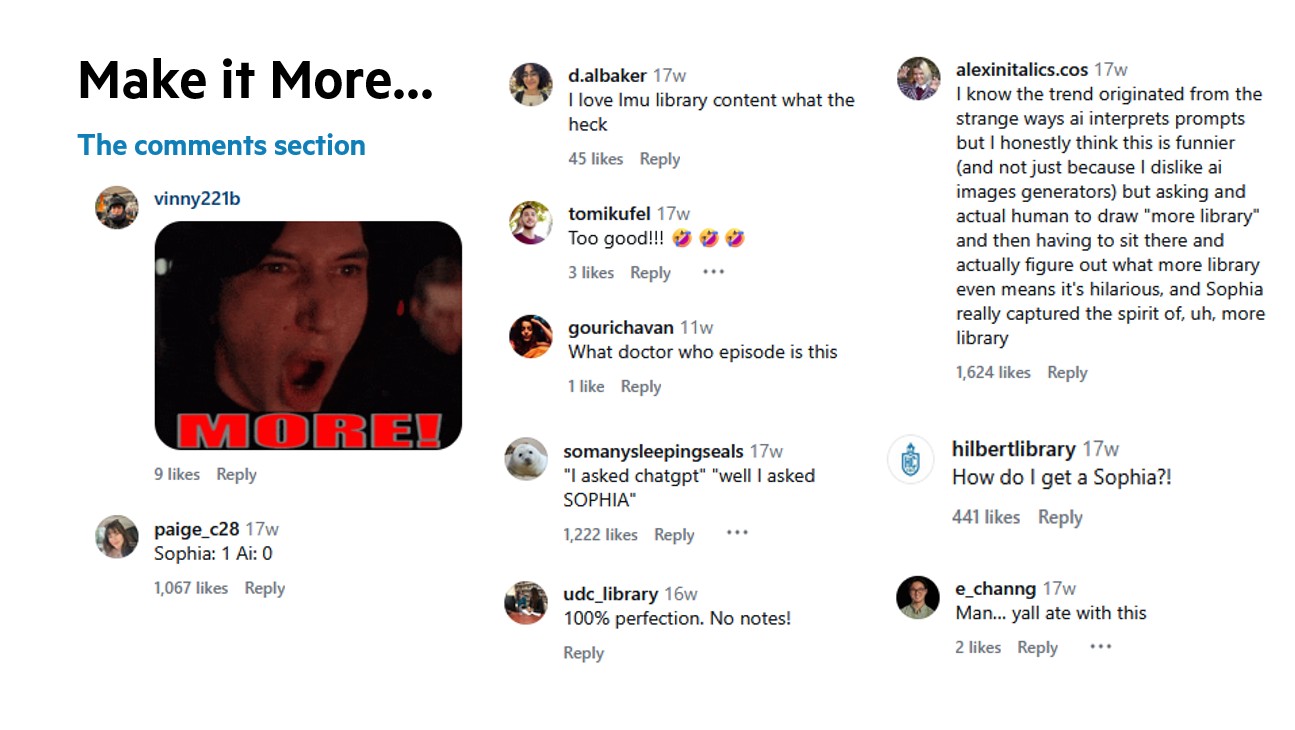
Favorable comments such as "I love LMU library" and "Too good!" and "100% perfection"

But John, you may ask: what if I want to use AI generated art? Well, I’m here to tell you using AI-generated art in library marketing and outreach rarely goes well. In fact, in all the examples that I found, the response was either outright negative or dead silence. [At this point in the presentation, I shared some examples from academic libraries. I’m not reproducing them here because I don’t think it would be fair to let them live on in infamy. Most of the AI-generated posts have since been deleted. But here are some examples of the comments]
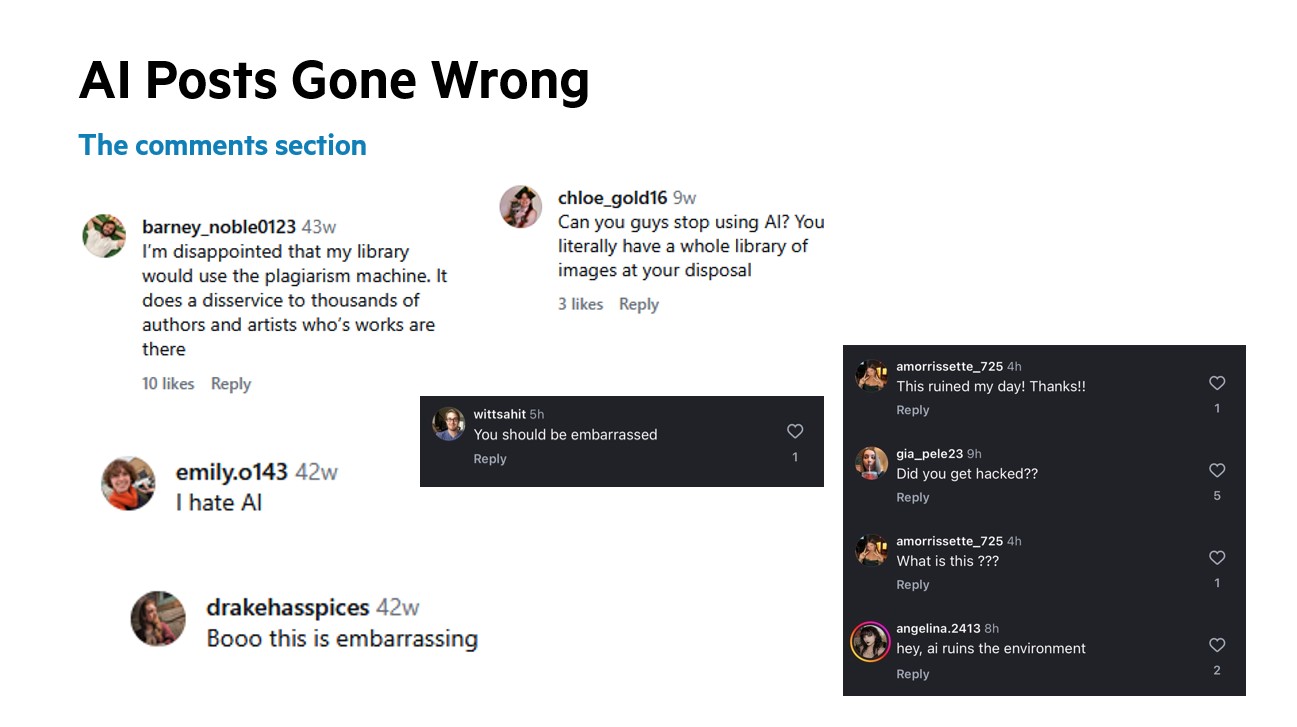
comments such as "did you get hacked?" and "can you guys stop using AI?"

And it’s not just in libraries. Here are some of the comments from the 2025 Coca-cola holiday commercial that was entirely AI-generated. As one commenter noted: “You know the entire point of these seasonal ads is to pretend you aren’t a soulless mega corporation, right?”

Take a look at the top of the comment section from a New York Mets post that was literally just an AI video of an apple. I like the comment from Dylan here. “Could it have been that hard to go to the top of the roof and put an Apple on the ledge of the building and film it?”

Some of this anti-AI art responses hit pretty close to home in higher ed as well. Here were some of the top responses to UNC’s announcement about the launch of an AI studio. As one person wrote: “Literally no one asked for this.”

And I’m sure many of you heard about the Libby debacle, when it came out that they were ingesting AI-generated books, some of it being labeled as AI slop, which then made it into the packages of ebooks they provide to libraries. The comments were vicious and folks are still responding in this way even on more current posts.

Some companies are even mocking AI as a brand strategy, as you can see that strategy on display here in this Polaroid and Heineken ad, which is making fun of a wearable AI device. So what’s the takeaway here?

Trust matters more than style. Effort matters more than the end result. And using real people and real situations, especially on social media platforms, signals authenticity. This is especially true for cultural and historical institutions like libraries, museums, and archives.

What this talk is not about

I do want to say two things at this point: #1, I’m not just here to talk about social media (though, I am going to come back to it before the end). Instead, I want to talk about the many ways we foster authenticity at the William H. Hannon Library by intentionally focusing on the “faces and places” of the library and by centering the people of our community. What I’m going to present has immediate applications to how libraries do marketing and outreach, but also applies to what we put on our websites, what we show at our events, and what we present in the classroom.

And #2: this is not an anti-AI presentation, because I do think AI can support library outreach, especially in creating more accessible digital experiences, but this presentation is humans-preferred because Rule #1 of marketing is “make something people want.” And I’m here to show you that what people want more than anything, is to feel they belong, and using AI-generated content can be directly oppositional to that desire.

Theoretical background

So let me start by looking briefly at some of the research that undergirds a lot of what I’ll be showing you today. I want to bring your attention to two concepts I’m sure many of you are familiar with: sense of belonging and library anxiety.

Sense of belonging is an individual’s desire to be part of a community and their attachment to a specific place. It includes the ability to project oneself into a future that includes the shared experiences of that community. Library anxiety is the emotional state that arises when a student enters the library. This state can be characterized by stress, fear, shame and confusion.

Research across higher education consistently shows that belonging is a central factor in student success. Psychologists Baumeister and Leary define belonging as a “fundamental human motivation”, putting it alongside essential needs like those we see in Maslow’s hierarchy. And studies repeatedly confirm that students who feel they belong earn stronger grades, persist at higher rates, and experience better mental health (Goplan and Brady, 2019; National Academies of Sciences, Engineering, and Medicine, 2017; Walton and Brady, 2017)

At a campus level, belonging is often measured through three simple questions: whether students feel they can be themselves, whether they feel valued, and whether they feel part of the community. Students who answer “yes” to these questions are more likely to engage with campus resources, including the library, further reinforcing their academic success (Lu, 2023; Yeager et al. 2026; Strayhorn, 2012).

For academic libraries specifically, belonging is shaped largely through relationships: the small, everyday interactions that signal to students that they are seen, respected, and welcomed. In Portal, Couture et al. found that for first-generation students, real-life interactions with library staff are among the most powerful contributors to a sense of belonging. Reed (2025) similarly argues that social relationships with library employees are a primary mechanism through which belonging can be cultivated.

This aligns closely with the literature on library anxiety, a concept grounded in feelings of shame, fear of judgment, and uncertainty about how to navigate the library. A wide body of evidence shows that direct contact with librarians—whether through orientation programs, formal interactions, or informal conversations—significantly reduces library anxiety (Black, 2016; McAfee, 2018). Lackner (2022) summarizes this well: creating human connections that foster belonging is the antidote to library anxiety.

Ramsey and Brown (2018) note that inclusive atmospheres, diverse representation in promotional materials, and visibility of students from marginalized backgrounds help counter the “outsider” feelings inherent in impostor syndrome. Students need to see themselves in the library to believe they belong in it.

This all ties directly into our current conversation about library marketing and communication. Bedenbaugh (2016) and Tanner (2023) argue that “humanizing the library” is essential—not just aesthetically, but psychologically. Students respond more strongly to real faces, real places, and real interactions. Tanner’s findings are explicit: images of real humans perform better, while illustrated or artificial substitutes widen the emotional distance between the library and its users.

Recent research on AI-generated promotional content reinforces this concern. Carvalho et al. (2025) found that even when participants couldn’t reliably distinguish between human- and AI-generated text, the perceived effectiveness dropped as soon as they suspected a message was created by AI. In other words: the more content feels machine-made, the less persuasive it becomes.

To wrap this all up, emerging library-specific research underscores the link between belonging and academic outcomes. Scoulas identifies library employees as a central driver of inclusion. In a later study, Scoulas, Naru, and Yu (2025) connect students’ perceptions of library spaces, collections, and support services directly to their sense of belonging; echoing broader findings that belonging predicts persistence, motivation, resilience, academic achievement, and well‑being.

Across all this research, one message emerges clearly: Students feel like they belong when the library feels human. Belonging is built through authentic interactions and in environments where students feel recognized. These connections are what counteract library anxiety and support ongoing academic success.

Centering the human in library outreach

So let me now talk about how we do that at Loyola Marymount University. I’m going to focus on two areas: Centering the Human in Library Outreach and Centering the Human in Library Marketing. Let’s start with outreach and programming.
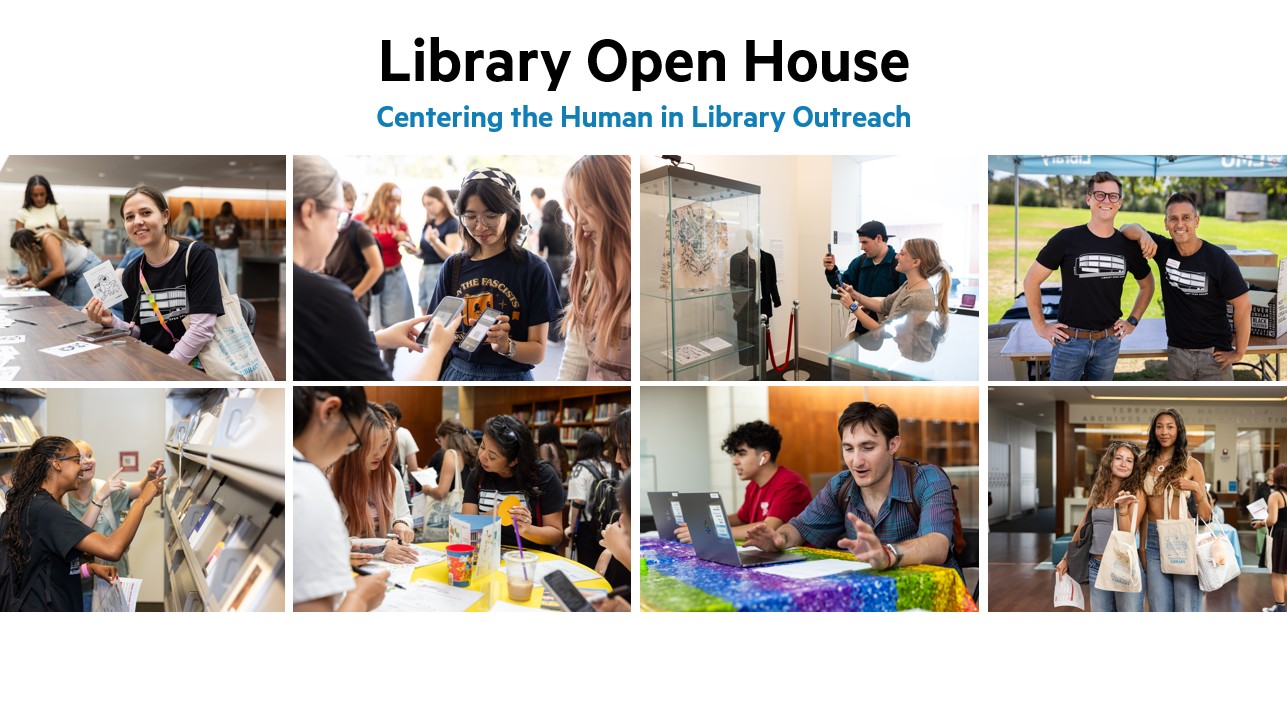
images of students in the library playing games

One the first experiences students have with the library at LMU is the Library Open House. We host this annual event every fall semester. It’s essentially a giant carnival where each library department hosts a table with games or a fun activity. The goal isn’t necessarily to teach students anything in particular (though that’s always nice if we do). Instead, our main goal is to introduce students to the “faces and places” of the library. Meet library staff. Explore our building. And hopefully form a bond between staff and students within the physical space of the library.

At the end of the event, we ask students “To what extent do you feel comfortable asking library staff for help?” and for the past four years, 98% report feeling comfortable or very comfortable asking for help after attending the library open house. As one student told us: “It was a very fun and interactive event that helped me feel more comfortable about going to the library in the future. I also was able to meet new Lions while playing the games and exploring all levels of the library.” and “It was great and the energy of the staff made the library a safe/comfortable environment.”

These two comments (and there’s way more where this came from), respectively speak to both reducing library anxiety and fostering a sense of belonging, through the act of person-to-person connection.
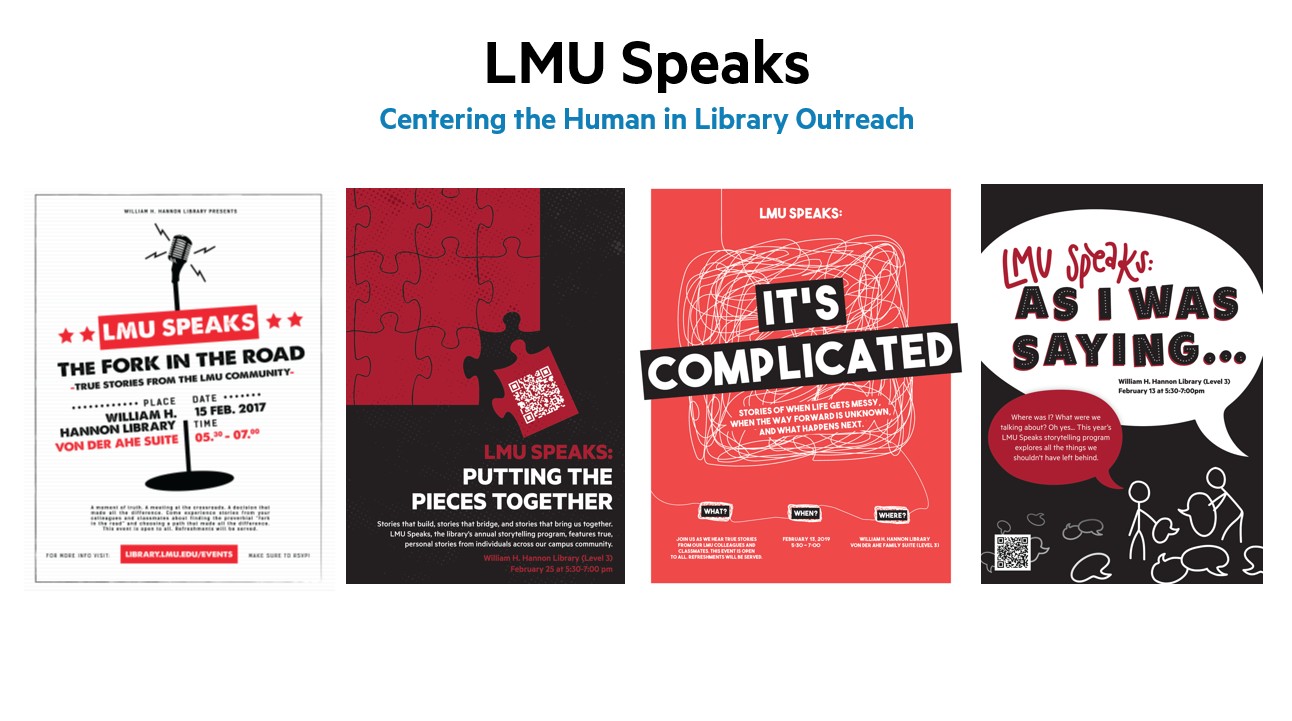
posters from LMU Speaks

Another unique event that we’ve hosted for the past 10 years is LMU Speaks. This is a storytelling program, similar to The Moth or NPR Storycorp, where we ask 5 members of our campus community to tell a true, personal story around a central theme. We always invite a mix of faculty, staff, administrators, and students; and the themes are things like “The Fork in the Road” or “Standing on Business” or like we did in 2021 “Hitting the Reset.” At the end of the event, we ask attendees whether they spoke with at least one person they’d never met before.

We also ask them if, as a result of attending this event, they feel a stronger connection to LMU and 100% agreed or strongly agreed. As one attendee noted this past year: “I learned that everyone has struggles you have no idea about that show up in their life in so many ways.” This is fostering a sense of belonging: by helping students see themselves in other students, faculty, and staff.
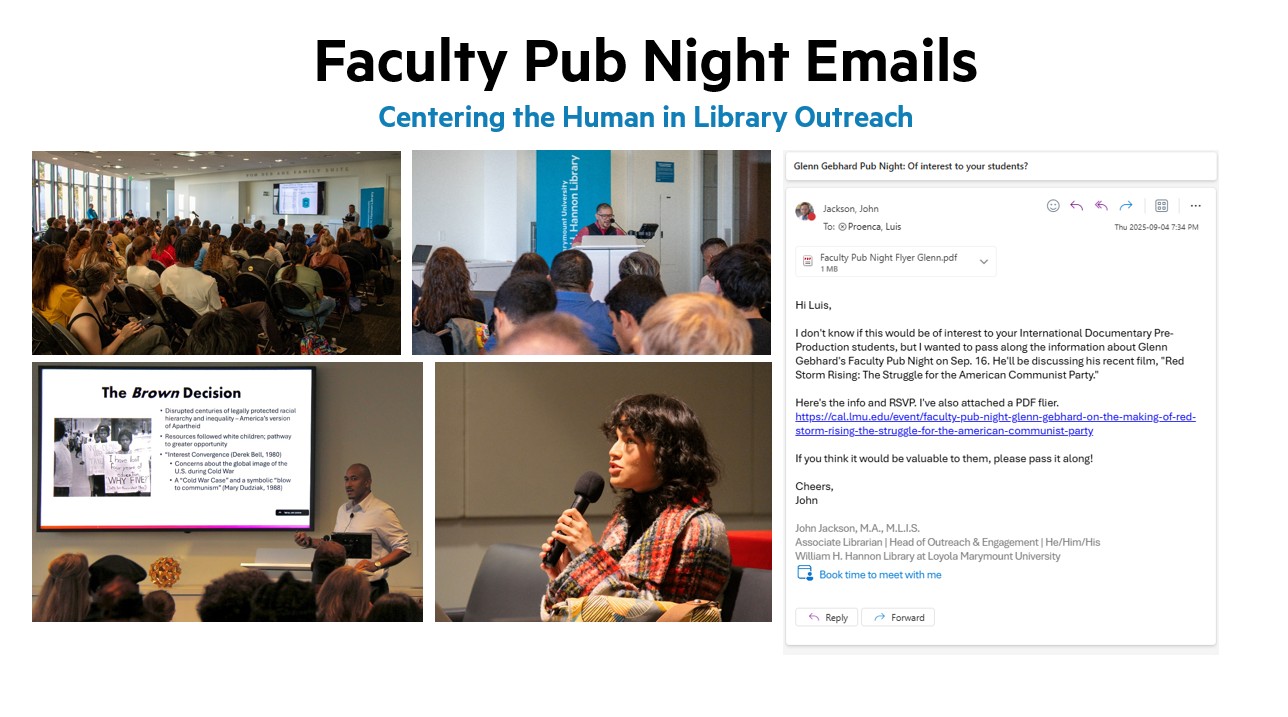
photos of students listening to a speaker; the speaker at the podium; and a copy of the email invitation

But making these human connections isn’t just something that happens during large, public events. At LMU Library, we also do this behind the scenes. Like many institutions, we have an email marketing platform that allows us to quickly create mass email campaigns. But we also rely heavily on personal, one-to-one email outreach. For example, we have this speaker series called “Faculty Pub Night” where we invite faculty to speak about their latest “publication.” We also serve beer and wine so it’s like a pub with pubs. (Get it?) Anyway, in order to build an audience for this series, my team and I comb through the course catalog and identify specific classes that we think might enjoy whatever the topic of the Faculty Pub Night is. We then individually email the faculty teaching those courses to invite them and their class to the event.

This work is time-consuming, but it also has a much higher ROI than mass emails campaign. It might take me an hour to personalize and send out 20 of these invitations. But if just 1-2 promise to bring their classes? Well, then I’ve got a packed room at our next event. It’s worth the effort. And it’s built on the personal connections that me and my team have built with many of these faculty over the years. They trust me not to spam them and to only contact them if I really think it’s worth their time.
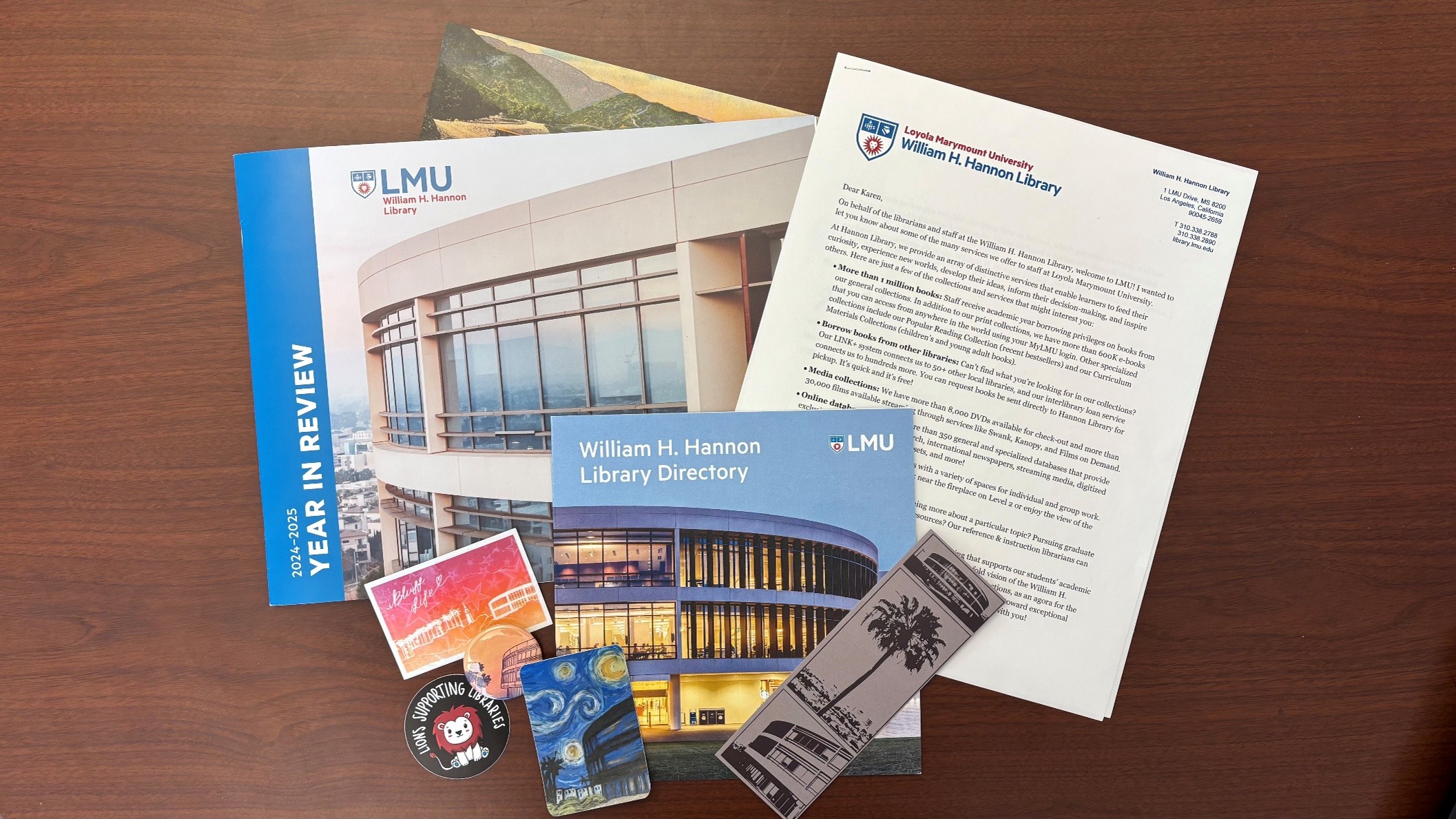
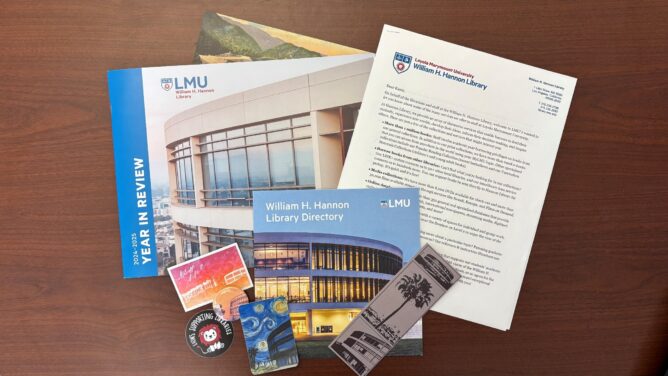
sample of items in the welcome packet that include bookmarks, magnets, stickers, a letter, and the library report

Finally, we send personalized welcome packets to all new staff and faculty at LMU. I know, this sounds crazy. But we get a list of newly hired staff every two weeks from Human Resources. It’s usually about 10-15 people at most. Since we can look up their contact info in Outlook, we put together a packet that includes a welcome letter, our latest annual report, and some library merch. One month after sending those letters, I follow up with a personal email inviting them to come take a one-on-one tour with me of the library, where I talk about the services the library provides for university staff. I end up doing about 2-3 personal tours per month for new employees.

Centering the human in library marketing

So that’s just a sample of what we do to center the human in outreach and programming. Now, I want to shift from talking about events and circle back to talking about marketing and the ways in which we center the human in our external communications work.

When I create content for our external communications, I always strive to center our library users and their personal stories. Last year, we created a six-part video series about some of the people who use LMU library regularly, folks we called our “Library Fans.” Here’s one video about Alexsiya, a graduate student, a parent, and a frequent visitor to our library.

One thing that I think is clear from that video is that the story matters. And some mediums are better at telling stories than others. In the year of our lord 2026, video is king. Primarily short form video. It’s the primary way that most students consume media, especially among teens, 73% of whom, according to Pew Research, reporting using sites like YouTube daily. Of course, anyone who uses Instagram or TikTok knows that the algorithms for both these platforms prioritize video over static images. So if you want you stories to actually get any eyeballs, you really need to focus on developing video content. At LMU, instead of posting static graphics or digital fliers, we primarily focus on promoting our services through video using our own students and staff. Here are two examples of the ways we’ve promoted our film collections at LMU Library.

Now, those videos are fun, but creating video content has a steep learning curve. And the expectations for quality keep getting bumped up a notch all the time. So if video production isn’t in your tool kit, at least use photography. Again, centering real people and real library spaces, preferably your own. Don’t use stock photography: your students can tell.
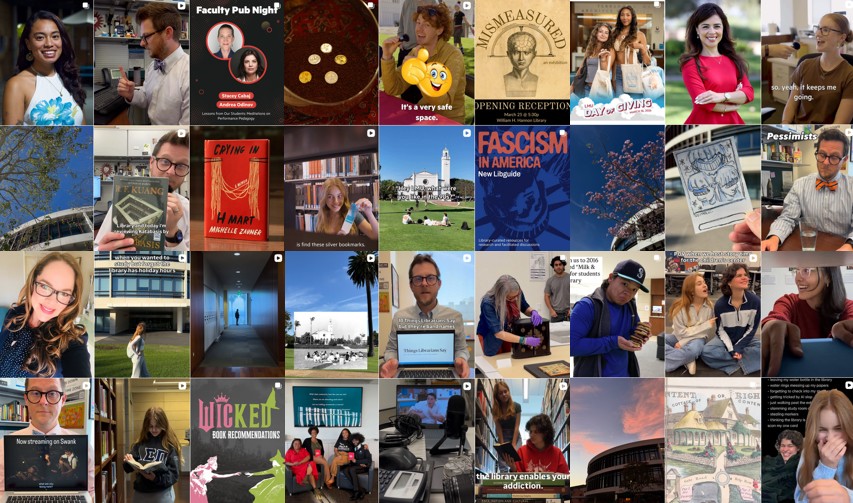
collection of screenshots from the library's instagram page

49% of the social media posts we’ve created since August 2025 (183 out of 376 total) include photography or video of current LMU students, faculty, staff, or librarians. And that doesn’t include archival photos, like images of students from the university archives, which are also very popular. If you include that, it’s closer to 57%. Only 6% of our IG posts are event fliers and yet we still have high attendance at our events. And our engagement since August 2025 is through the roof. Our content interactions are up 6.6 thousand percent.

One really easy way to center the human in library marketing is to utilize student talent. At LMU Library, I hire a student graphic designer, a student videographer, and 2-3 student social media assistants to help create content each week. Here’s an example of one video that Petra and Jmac made asking folks how they use they library. All of these students were interviewed with consent (and spoiler: students were asked in advance if we could film them), but their responses are genuine and they showcase how actual students actually use our library. I’ll just show you the first one, which we made after someone suggested to me that students don’t know they can use the library without actually going into the library. The resulting video turned out to be a great way to highlight our online resources.

The video work we do is still relatively young in its development. I just started hiring a student videographer a few years ago, but for the past 10 years, I’ve hired a graphic designer, usually a junior or a senior, to help create unique, promotional materials for our events and our collections.
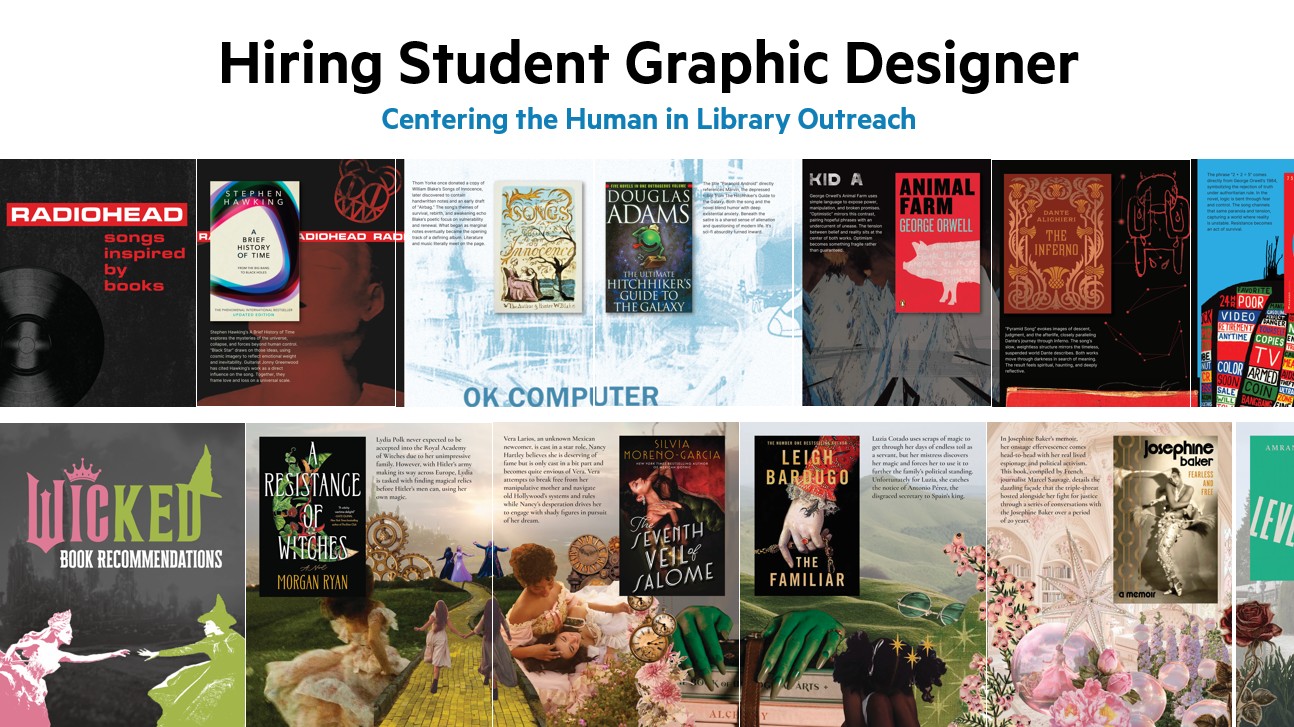
carousel of images, the first showing Radiohead covers with book recommendations and the second showing Wicked-inspired collage with book recommendations

Here are a few examples of Instagram carousels my current student, Sophia Chavez, has created to highlight our Staff Picks LibGuide and our Popular Reading Collection. This Radiohead carousel from a couple months ago knocked our anti-AI library video, the one I showed you at the beginning of this presentation, knocked it out of the top spot on Instagram. It has since been shared more that 2600 times, saved by over 4,000 people, and currently has over a 156,000 views. This post alone brought more than 800 people to our profile page. All of this is hand-illustrated, or at least human-designed promotional materials. However, there’s a caveat.

Content development is one thing. But content strategy requires a more experienced hand. Someone who can see the connections between the library’s value, our strategic priorities, the needs of our users, and the university’s mission. So I do just want to make it clear that I’m not suggesting you hand over all your marketing and promotional work to students, but they can be and should be essential partners in that work.

Librarians at the forefront

Instead, I would like to recommend that you focus on the more stable faces of your library. In keeping with our theme of centering the human, I encourage you to think of yourselves as local influencers. Specifically for your campus community. Or if not you, then think of 1-2 of your colleagues who might be able to do this type of work well. Going back to the research I spoke about earlier, when students know someone who works in the library, when they can put a face to a name, and connect that face to the library as an organization or the library as a service, that will positively reduce library anxiety. That will foster sense of belonging. Even if that face is just someone they regularly see on the library’s website, YouTube page, or social media.

There are a few libraries that I believe are doing this really well. Oklahoma State University Libraries, Kansas State, University of Wyoming, UCSB, Emerson College, and William and Mary Libraries, just to name a few. They have created “recurring characters” in their external communications that have backstories, and lore, and complicated relationships with other recurring characters. Whether it’s library student employees or the dean of the library, there’s a real human face that students can come back to again and again. I don’t think it’s any coincidence that some of the most successful academic libraries on social media are also the libraries that regularly feature people in their promotional content.

Conclusion: A critical framework

So what have we learned. We’ve learned that reducing library anxiety and fostering a sense of belonging are essential to student engagement with the library. We’ve seen how AI-generated content can create the opposite effect and cause students to feel a disconnect with the library’s brand. Finally, we saw examples of how the library’s “faces and places” can be leveraged to strengthen the connection between library users and the library organization.

I want to leave you with some guiding questions and provide you with a critical framework: What value(s) do libraries offer for their community? Does automating our voice and giving over our brand to AI-generated content increase that value? Does it support our values? I would argue that it does not. The library’s voice is not just a tool: it’s a reflection its values. By centering human intelligence in our messaging, we model the kind of discernment we hope to cultivate in our students, discernment that is linked to questions of justice, community building, and community values. We can ask ourselves:

  1. Does the time/effort this saves me erase an opportunity for building a relationship with my community/users? 
  2. How will my community respond when they discover this content is AI generated? (i.e., do you have an art or MFA program on campus?)
  3. Does using AI-generated content reflect the values of my library? My university?
  4. What practical opportunities does not using AI present? (e.g., student employment, building my skill sets, deep learning)

This is a critical framework for thinking about the use of AI-generated content in library outreach and marketing. Looking at these various dimensions, I have critical questions you should ask yourself, why it matters, what might be some indicators of a human-centered practice, and what are some possible red flags. I’ve listed here 8 dimensions for consideration: belonging, authenticity, relationship-building, community impact, equity and inclusion, mission and pedagogy, labor, and brand health.
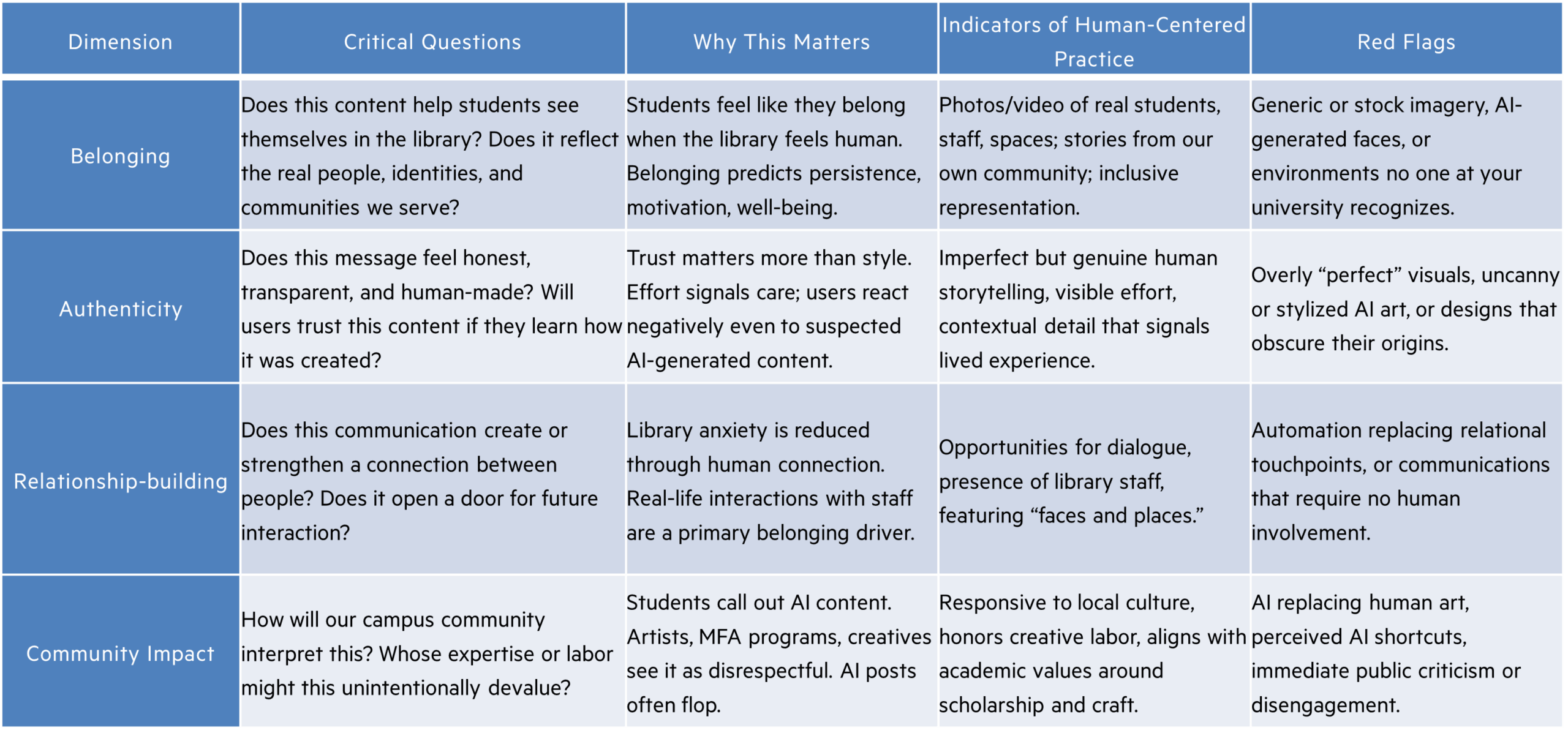
For example, before using AI-generated content in your outreach, consider how this impacts belonging: does the content I’m creating help students see themselves in the library? Because when they see themselves in our future…. Literally see themselves and their friends in photographs… this helps strengthen persistence and motivation. On the flip side, and this is the “red flags” column, if you’re using AI-generated images, it’s essentially the same as using stock photos: no one will recognize themselves in your messaging.

And here’s part two. For example, looking at DEI, does using AI-generated content reflect diversity or exacerbate imposterization? This matters because students need to see themselves to feel they belong. If you’re doing this right, you’ll have real people telling real stories, rather than homogenized or stereotyped imagery.
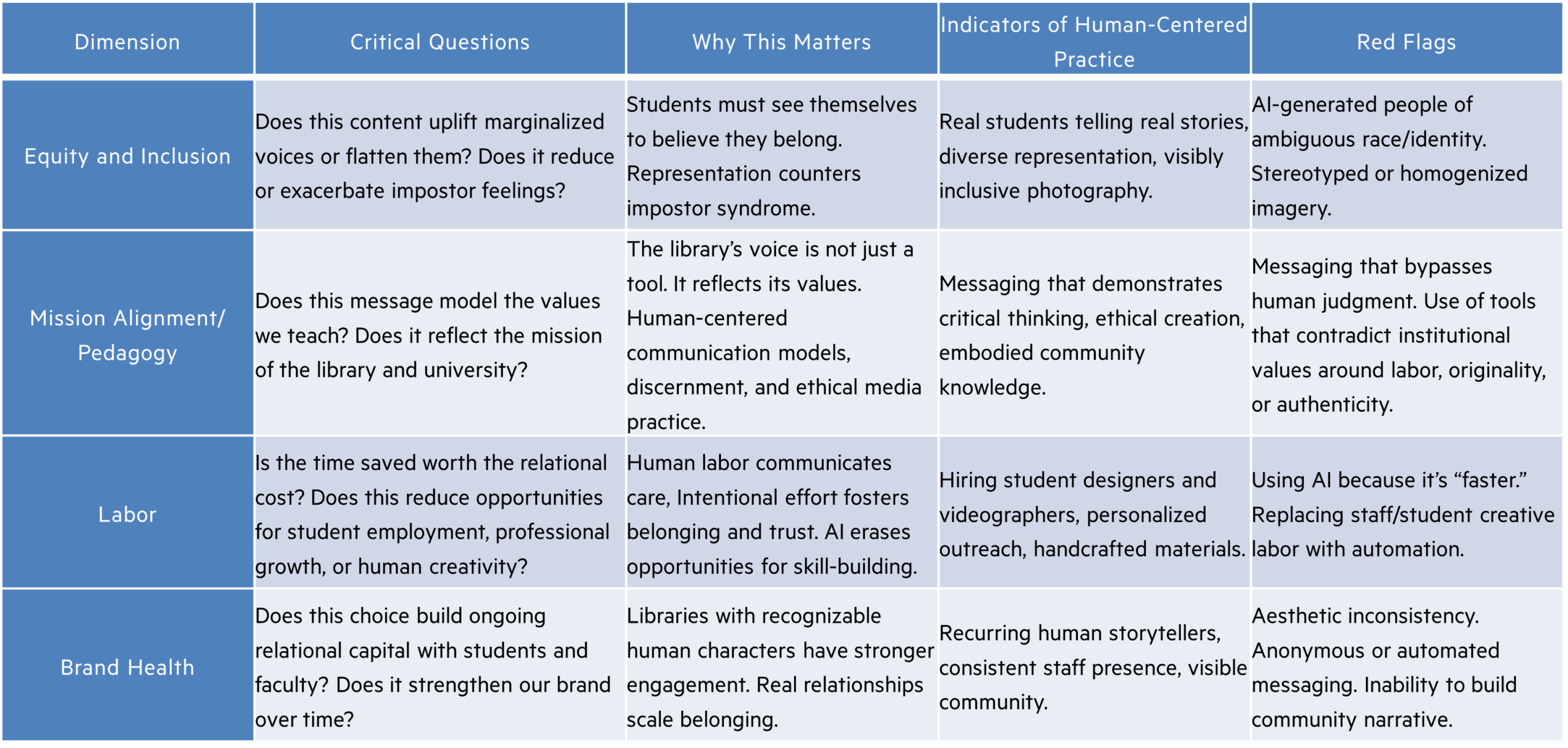
This critical framework is applicable not just to the outreach we do through marketing and promotional work, but I would argue it’s also applicable in the classroom, on our websites, and at our service desks. Any one of these dimensions: belonging, authenticity, relationship-building, community impact, equity and inclusion, mission and pedagogy, labor, and brand health… all of these are impacted when we make the decision to outsource our library’s voice to AI-generated content.

And that’s it! I hope you enjoyed the presentation. Again, please feel welcome to connect with me on LinkedIn! Thank you so much for listening!

References

Baumeister R. F., Leary M. R. (1995). The need to belong: Desire for interpersonal attachments as a fundamental human motivation. Psychological Bulletin, 117(3), 497–529.

Bedenbaugh, R. A. (2016). Marketing is Our Game: Tackling the Library Awareness Gap. Public Services Quarterly, 12(4), 321–328.

Black, S. (2016). Psychosocial reasons why patrons avoid seeking help from librarians: A literature review. The Reference Librarian, 57(1), 35–56.

Carvalho I., et. al. (2025), “Beyond human touch: evaluating the effectiveness of AI, human, and hybrid-generated tourism promotional texts”. Journal of Hospitality and Tourism Insights, 8(10), 3804–3824.

Couture, J. et al. (2021). “We’re Gonna Figure This Out”: First-Generation Students and Academic Libraries. Portal: Libraries and the Academy, 21(1), 127–147.

Gopalan, M., & Brady, S. T. (2019). College Students’ Sense of Belonging: A National Perspective. Educational Researcher, 49(2), 134-137.

Lackner, J. (2022). Confronting library anxiety. Public Services Quarterly, 18(3), 224–231.

Lu, A. (2023, May 9). How to Turn Your Campus Into a Place of Belonging. The Chronicle of Higher Education.

McAfee, E. L. (2018). Shame: The emotional basis of library anxiety. College & Research Libraries, 79(2), 237–256.

National Academies of Sciences, Engineering, and Medicine. (2017). Supporting students’ college success: The role of assessment of intrapersonal and interpersonal competencies. National Academies Press.

Ramsey, E., & Brown, D. (2018). Feeling like a fraud: Helping students renegotiate their academic identities. College & Undergraduate Libraries, 25(1), 86–90.

Reed, E. (2025). Inclusion and Empathy Are Not Enough: Cultivating Student Belonging in the Academic Library Through Compassion. Portal: Libraries and the Academy, 25(4), 625–641.

Scoulas, J. M. (2021). College students’ perceptions on sense of belonging and inclusion at the academic library during COVID-19. The Journal of Academic Librarianship, 47(6), 102460.

Scoulas, J. M., Naru, L., & Yu, Y. (2025). Factors Influencing Undergraduate Sense of Belonging at a Public Research University. Journal of Library Administration, 65(3), 343–360.

Walton G. M., Brady S. T. (2017). The many questions of belonging. In Elliot A. J., Dweck C. S., Yeager D. S. (Eds.), Handbook of competence and motivation (2nd Edition): Theory and application (pp. 272–293).

Strayhorn T. L. (2012). College students’ sense of belonging: A key to educational success for all students. Routledge.

Tanner, L. (2023). “How do you do, fellow kids?”: Staying relevant with college students on your academic library’s social media. Public Services Quarterly, 19(3), 233–239.

Yeager D. S., et al. (2016). Teaching a lay theory before college narrows achievement gaps at scale. Proceedings of the National Academy of Sciences, 113, E3341–E3348.
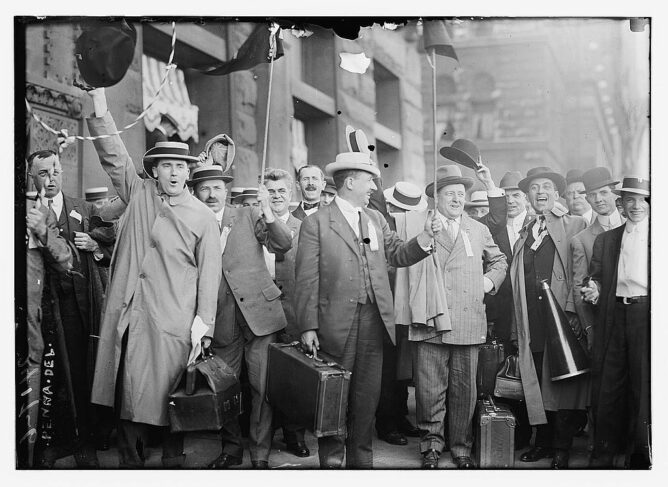
black and white photo of men in suits and pork pie hats celebrating

I’m at the point in my career where I can look back and see trends. I can vividly remember my early obsession with professional networking (2009-2011), the deep dive into critical pedagogy and instruction (2011-2015), the slow rise into outreach (2015-2017), and the crossroads that led to management (2018-present). Assuming I retire between the age of 60-65, this means I am just approaching the half-way point.

That’s a sobering realization.

And it leads me to think “what’s next?” I’ve been invited to apply for associate dean and AUL positions. I don’t yet know if that’s the direction I want to go. I’ve also considered stepping back from management to focus entirely on strategic communications and assessment. I’m not sure that’s a direction I want to go either. Frankly, I’m undecided on what my immediate next step is.

And that’s OK.

What I do notice, however, is an emerging fascination with the professionalization of outreach work. Within academic libraries, there are certain areas of work that are highly professionalized: e.g., reference and instruction, special collections, collection development, e-resources management, and systems. Basically, if there are multiple annual academic conferences dedicated to your line of work in libraries, you can consider your area to be highly professionalized. Also: multiple academic journals on the topic; multiple ACRL sections and interest groups; and professional competencies.

Outreach librarianship, as a stand-alone position, emerged alongside distance education librarians at the dawn of the internet in the 1990s and early 2000s. So in the grand history of academic librarianship, it’s one of the younger specializations. We do have academic journals and we just recently adopted professional competencies, but we are no where near the level of professionalization that, say, reference librarianship or collection development work is at. 

Outreach librarians take many forms: student engagement librarians, communication librarians, first-year experience librarians, various forms of liaison work, management, and instruction-adjacent positions. We also wear many hats, everything from program development and community engagement to marketing and social media strategy. Some are housed within reference and instruction departments, user services teams, or administration; others (like myself) are stand-alone departments. 

With what remains of my career, I think that I want to continue to professionalize the work that outreach librarians do. Developing standardized assessment protocols. Advocating for the hiring of uniquely qualified and skilled individuals. Championing the work of academic libraries that support notable outreach projects. I’m doing some of this work already as the Marketing Column editor for Public Services Quarterly and as a board member of the Library Marketing and Communications Group.

To those ends, these are some of the projects I’d like to work on:

  • Co-lead research that helps to further codify academic library outreach as its own LIS subfield
  • Help to build a robust set of outreach assessment tools
  • Form a community of practice around academic library ROI, storytelling, and communicating value
  • Formally highlight notable examples of successful academic library outreach (see also: RIAL)
  • Write a new book on academic library outreach 
  • Develop a new toolkit for library outreach (let’s bring back the ARL SPEC kits!)
  • Co-teach a course on academic library outreach 

Just to name a few.

Not that I have the time for any of this right now, of course; but as I look at the next 20-ish years of my career, I do want to start moving towards “the next thing.” And if that can be something that leaves an impact on the future of the profession by making it possible for more folks to pursue outreach librarian work along pathways that feel supported and well-trodden, that would be worth the journey.

banner image: Penn[sylvania] Delegation (via library_of_congress on flickr)

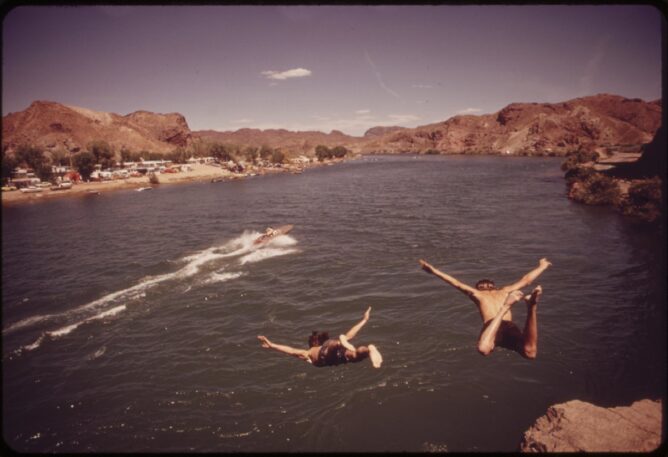
two divers over a lake

I am interested in the future because I expect to spend the rest of my life in the future. Charles F. Kettering, quoted in the L.A. Times, 19 July 1939.

Recently, I was invited by Angela Hursh, manager of engagement and marketing for NoveList and owner of the “Super Library Marketing” blog, to give my predictions for what 2026 will bring to library marketing. It was an honor to have my thoughts sit alongside other notable library marketing folks. I was the only academic librarian included in the piece. So doubly honored! If you haven’t already, jump over to Super Library Marketing to read the entire post.

Library marketing in academic libraries shares some similarities with marketing in public libraries, but there are significant differences. Our audience tends to be more narrowly confined by age and education level. We also have high user turnover: as much as 25% of our population leaves each year to be replaced with new users. Moreover, we usually only get to work on building connections with them for 2-4 years before they cycle out of our system completely. On the flip side, they can often function like a captive audience, depending on how integrated the library is with the curriculum. The communication landscape of a university is also dense, with plenty of opportunities for cross collaboration between departments. 

All this to say, my additions to Angela’s piece might benefit from some additional context, especially since I came at this from the perspective of an academic librarian. So below I’ve included my quoted sections of the original post, followed by additional commentary (that wasn’t included in my original contributions but were certainly in the back of my mind while writing them).

Prediction: “In 2026, social media will be more about connection than reach.”

My Quote: “It will be a challenge for libraries to engage with users who rarely step beyond those private spaces, [e.g. groups chats and DMs]” states John. “Combine this with algorithmically defined feeds, and now you have a situation where a library’s content may never get any eyeballs unless it can simultaneously ‘stop the scroll’ and be worth sharing. I expect this will drive library marketers to create content that is intentionally designed to be shared across platforms (i.e., there’s some social benefit to the user if/when they share the library’s content), but that may also leave marketers in the dark concerning assessing the true impact of any digital campaigns.”

Commentary: Being successful on social media is more difficult than it used to be. Platforms no longer offer chronological feeds. The FYP is the new default. The only way for me have a chance at getting student eyeballs is to (1) create content that impresses the algorithm or (2) create content that has a high benefit-to-share ratio. The second of these is easier to create, though perhaps more limiting. Libraries that can achieve 1 and 2 simultaneously will be the most successful and it’s one of the reasons I rely on shares/sends to measure social media success. However, once it leaves the platform (e.g. gets shared to the group chat), it becomes impossible to track so the true extent of the word of mouth will be unknown. 

Prediction: “Libraries that invest in marketing as essential infrastructure, rather than an add-on, will be better positioned for sustainability and trust.”

My Quote: “Smarter marketing, building connections, hyperlocal relevance: none of this will be possible without content strategists and content creators who have the right skills, experience, staff, and equipment to bring this to bear,” contends John. “It behooves library administrators to commit when it comes to external communications. It’s not enough to have an amazing library. You’ve got to keep selling it, over and over and over and over again.” 

Commentary: If you build it… they probably won’t notice. It is the year of our lord 2026. We should not be having to explain why marketing, communications, and outreach are essential functions of the academic library. The pitfall that I see most academic libraries fall into is that they assign these essential functions to non-professionals. A committee, student employees, the newest hire, the most eager employee. Not that these folks are not capable, but quality marketing and strategic outreach comes from experience and skills. The library’s place within the campus ecosystem and student life is not a given. We need skilled storytellers who can capture hearts and minds. So if you want to succeed in this area, hire and staff like you mean it. 

Prediction: “The most effective library marketing in 2026 will make people feel seen, supported, and welcome, not just informed.”

My Quote: “The media success of libraries like Columbus Metropolitan Library and Los Angeles Public Library is going to drive more libraries to invest in creative storytelling,” he says. “The libraries that can muster the right amount of creativity, leadership, and resources will focus on slow storytelling (think: Craighill or Planet Money) and serial content (think: “Roomies” by Bilt or “Chit” by Jay Renshaw). This will likely drive libraries to mimic each other on social, so the challenge for any library content creator will be to find a way to rise above it all and deliver content that is both uniquely entertaining and directly relevant to their communities.”

Commentary: Your website is not a bulletin board. Your e-newsletter is no a bulletin board. Social media is not a bulletin board. Our library users and our staff need to be the center of our messaging strategy. Whether it’s through highlighting library fans or turning your staff into main characters, folks are looking (1) to be entertained and (2) to form parasocial relationships with the organizations they love. As library marketers, we are tasked with wooing our audiences through connection, understanding, and just the right amount of spice. You can’t “template” marketing. If it were that simple, companies would not pay six figure salaries to content strategists and “storytellers.” If anything, using templates or following a formula is exactly the opposite of effective marketing because the entire point is to rise above the noise in order to connect what your users want to what you have to offer. Each library has unique campus communities to appeal to, so invest in both taking the time to understand those communities and hiring folks best skilled to foster those connections through creative outreach.

What I’m reading 

The Age of Academic Slop is Upon Us by Seva Gunitsky: “It seems people were using AI to generate terrible manuscripts and then shotgun-spraying them across the academy with little regard for quality or fit […] And these papers won’t be bad. They’ll be narrowly useful, methodologically sound, and for the most part not very interesting.”

Behind the Scenes with Milwaukee Public Library’s TikTok by Hannah Arata: “Each video, whether it takes 10 minutes or seven hours to create, becomes an invitation for someone to rediscover their library or step inside for the first time. As MPL continues to experiment and learn from its data, staff are proving that libraries can be both rooted in tradition and innovation.”

We’re not nostalgic for 2016 — we’re nostalgic for the internet before all the slop by Amanda Silberling: “As AI increasingly encroaches on everything we do on the internet, 2016 also represents a moment before The Algorithm™ took over, when “enshittification” had not yet reached the point of no return.”

Links to the past 

  • 1 year ago: Duke University’s Lilly Library was getting “cored like an apple.”
  • 5 years ago: My library was winning the ACRL Excellence in Academic Libraries Award!
  • 10 years ago: I started task blocking my days. I still do this and it’s the only way I’m able to get as much done during my week as I do.
  • 15 years ago: I was singing the praises of online education. If I only knew what the next decade would bring.

Overheard online 

Recently I logged in to the photo app and the short form videos were ALL about #Godzilla. Hadn’t seen anything related on that app in a while so who knows why, but I am happy about the result. @Anneheathen on Mastodon

banner photo: Diving into the Colorado River at “Parker Strip,” a favorite swimming spot of southern Californians and Arizonians, April 1973 (source: U.S. National Archives on flickr)

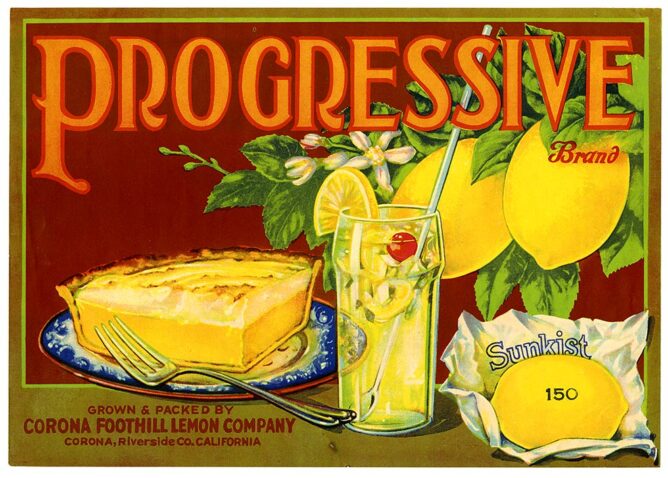
ad for progressive brand lemons, with lemon pie, lemonade, and lemons

A salesman is got to dream, boy. It comes with the territory. Death of a Salesman, Arthur Miller (1949)

We made it through the first quarter of the 21st century. By the skin of our teeth, if you ask me, and we’re still holding on by a thread. 2025 wasn’t a spectacular year for me personally, but it also wasn’t the worst I’ve experienced. I had some small wins at work. Some bigger wins at home. Let’s call it a rebuilding year. 

2026, on the other hand, may prove to be a doozy. I’m scheduled to go up for full librarian. Our university is under new management. And I’m currently signed on to two major libraries projects: developing a marketing kit for open educational resources and helping to re-launch Project CORA. My team was also cut 25% so I’m doing the proverbial more with less. So it goes.

As is customary this time of year, I’ve been thinking about where I want go and how I want to be in 2026 (or, how I want to go and where I want to be). I saw a post recently where the author “manifested” their professional hopes for 2026. I liked the format so here I go. Here’s what I’m hoping to manifest for 2026:

  1. The “Recently in Academic Libraries” posts really pop off and I can justify spinning those into a regular Substack or Patreon newsletter.
  2. We assemble a team of academic library marketing/outreach folks to conduct hardcore research that helps codify library marketing/outreach as its own LIS specialization/subfield. 
  3. The academic library marketing folks build a vibrant online community (preferably not on Facebook).
  4. I’m invited to give a keynote about marketing and outreach in academic libraries.
  5. Some academic library—doesn’t have to be mine—starts going viral on the regular in the same way that LAPL and Milwaukee Public have, drawing attention to the role we can play as cultural shapers.

It should be apparent from the above that one of my current obsessions is the professionalization of academic library marketing and outreach work. I’ll admit it: I’m somewhat jealous of my colleagues in public libraries, museums, and other cultural institutions who are doing amazing marketing work and who are rightfully drawing national attention for it. As an outsider, it appears that marketing and outreach work in these organizations is treated as more essential to strategy and operations (though, I’m sure it doesn’t feel like that from the inside!). I want to see that success—and the support that that success requires—manifested in academic libraries as well. 

What I’m reading 

Why AI Didn’t Transform Our Lives by Cal Newport. “Such breathlessness now seems rash.” The AI agents that so many in tech said would revolutionize our lives are surprisingly incapable of simple tasks. Or, to put it differently, living and thinking in meat space is far more complicated than we give it credit for. 

The State of Library Marketing 2026 by Angela Hursh. The #1 challenge for respondents to Angela Hursh’s annual survey is time and capacity:  “41 percent of respondents stated they feel they lack the time or resources needed to perform their jobs effectively.” I definitely feel the stress of all five challenges highlighted. 

Research as Leisure Activity by Celine Nguyen. “I truly think that autodidacts are responsible for all that is good and great about alternative culture.” When I finally win the lottery and no longer need to work for a living, I look forward to spending my days as a leisurely researcher. 

Links to the past 

  • 1 year ago: I think about this quote at least once a day. 
  • 5 years ago: I set out to write every day. Hm, I should do that again.
  • 10 years ago: I’m still “the guy who wears the bow ties.” Why stop now?
  • 15 years ago: Some advice from ALA Midwinter on personal branding online. Most of this still holds up! 

Overheard online 

ways you can tell I am in fact a trained librarian  despite the unusual career path: just sent a text which included the phrase “✨ structured metadata ♥️” @thatandromeda on Bluesky

banner photo: Lemon crate label, Progressive Brand, Lehmann Printing and Lithographing Co. (on flickr)

My colleague Ray Andrade and I recently published an article on our outreach successes (and some failures) with first-year college students. We utilize a home-grown mix of programming, communications, and 1:1 connections to foster student engagement.

Starting with the knowledge that using the library within their first semester at college is correlated with academic success, the outreach team and the Hannon Library have employed a variety of tactics to get students in the door. By creating engaging orientation videos, promoting the library at in-person campus fairs, fostering word of mouth by working directly with niche communities, leveraging existing communication channels and email marketing, and hosting an open house early in the semester, we have cultivated an ecosystem in which the library’s brand can take root and thrive.

Read the whole article at Marketing Library Services (now integrated with Computers in Libraries).

“Staff expect us to create posters and social media posts for every program but they’re also creating programs that the community didn’t ask for. So, when no one registers, marketing gets blamed. You have to have some tough skin to work in library marketing because everyone thinks they’re a better marketer and everyone is a critic.” (source: The State of Library Marketing in 2025: Survey Reveals New Obstacles and Frustrations)

Last month, I took over the marketing column for Public Services Quarterly, following Katy Kelly’s 10-year tenure at the helm. To signify the transition, Kelly and I co-wrote an article, “The Eras Tour of library marketing,” reflecting back upon the topics covered under her leadership and looking toward the future. 

At one point, I asked Kelly to consider the future of library marketing, and specifically to consider potential threats, to which she responded:

“Lack of respect. Marketing is a management function and library employees who do this work should be compensated at a managerial level or else they will leave, burn out, or quietly quit. In addition, they should be invited to participate in conversations regarding big changes or initiatives at the earliest juncture. Administrators who don’t recognize this will end up with more work and confusion internally and externally.”

Shortly after our article was published, one of my favorite creators, sidneymorss, posted the following on TikTok. The industry is different, but the vibe is the same as Kelly’s quote above. Someone please create a library version!

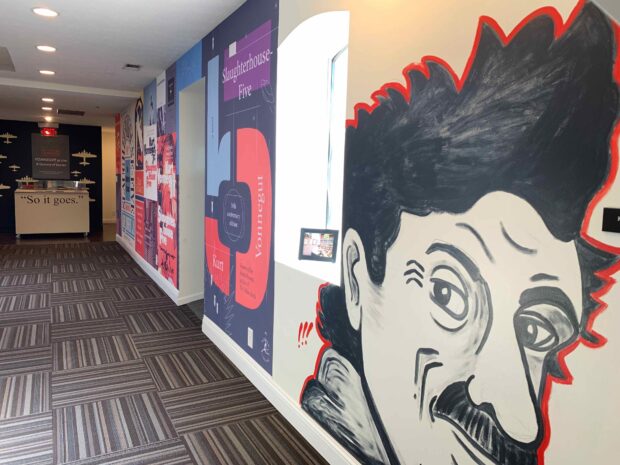
wall mural of Kurt Vonnegut

“Every passing hour brings the Solar System forty-three thousand miles closer to Globular Cluster M13 in Hercules— and still there are some misfits who insist that there is no such thing as progress.”

(Kurt Vonnegut, Jr., The Sirens of Titan, epigraph, 1959)

Last week, I attended the 2023 Library Marketing and Communications Conference in Indianapolis. This is one of my favorite conferences to attend. It’s relatively small, relatively affordable (with meals included!), and attended by people who get me. Regardless of whether we work in academic libraries, public libraries, as librarians or as professional staff, we all speak the same language. We understand that not everything can go on the website. We know that fliers are a net waste of everyone’s time. We know that creating social media content is a specialized skill that few people actually do well. We realize that more promotion does not equal more awareness. We understand the power of storytelling. We value having a consistent brand. And yes, we all spend too much times on our phones, but secretly (or not) we enjoy it. 

So here are a few of my takeaways from this year’s conference.

Burnout is real

Libraries cycle through outreach and communications folks like trends on Instagram. Constantly developing new ways to connect with users takes a toll on all of us. A number of sessions this year spoke to the necessity of setting up guardrails, taking time to step away, and the need to find ways to reconnect with your creative spark. Sadly, there wasn’t much talk about burnout being a systemic and organizational problem that needs to be solved at the management level, but that might be a result of there being so many new professionals in attendance.

Email is king, Instagram is queen, and existential dread

Everyone is looking for an excuse to get off X/Twitter. No one is interested in Threads. TikTok is banned in many states and the rest of us are reluctant to jump on. But email… email is king. Email offers a stronger analytics story, a closer connection to users, and a more dependable way to reach out. And it’s what our users want! A number of presenters confirmed what I’ve discovered at my own library: users prefer to be contacted by email. Instagram is a close second, but only as a vibe check. If email is for sharing information, Instagram is for sharing feels. 

Social takes way more time than people assume

If it wasn’t apparent from my opening, one of the best aspects of LMCC is the collective kvetching. One strong theme this year was how many of our colleagues misunderstand the complexity of our work, most notably the time it takes to develop content. A 10-second Instagram post may only take an hour to film, edit, and post, but what you don’t see are the countless hours searching for inspiration: finding the right music, twisting the arms of the right colleagues, waiting for the right time of day to film, coordinating with all the other communications going out that day. We spend far more time consuming content than creating it, but that’s necessary for understanding how our work fits in with the ecosystem of any given platform.

What I’m reading

How I’ve Changed My Thinking About Burnout by Anne Helen Peterson

“I am doing less. I am lowering the bar. I am loosening my schedule. But I also have a fuller life, with so many places to direct my attention and time. It’s both less busy (with work) and more busy (with other life) than ever before.”

Nobody Wants Their Job to Rule Their Lives Anymore by Eloise Henry

“If I had a shorter work week and a dignified salary then they’d get a well-rested, enthusiastic and switched-on employee. Instead, they’re getting a poor and exhausted worker.” 

Adopting the Perennial Mindset by Tara McMullin

“Quality-of-life guarantees could help people make life transitions—at any age—with more ease. And while these guarantees do benefit individuals directly, they also benefit our society. Fewer people scraping by, falling behind, or burning out because of unreasonable expectations is an overall cultural and economic good.”

Garden update 

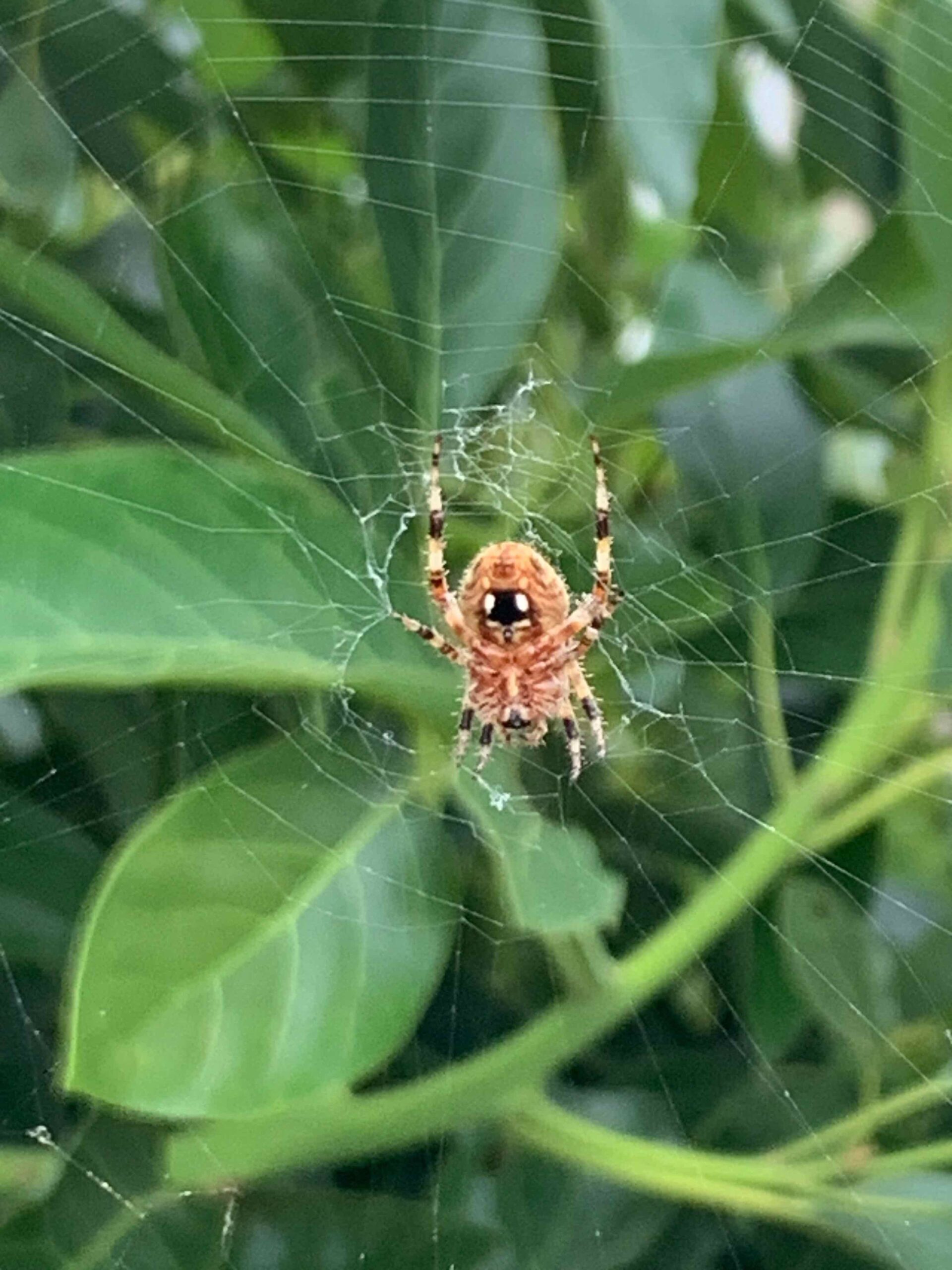
Until next year, friend! For about 6 weeks, this lovely orb weaver rebuilt her web between the top of my dwarf orange tree and the power cables running to our house. Each evening before sunset, she would meticulously reweave her web, which by midnight would already be full of flies and the occasional honey bee. I haven’t seen her for a few days so my guess is she either returned to being strictly nocturnal or, more likely, she mated, produced her offspring, and died. It was comforting to greet her each day when I came home from work. 

Links to the past

  • 1 year ago: Notes from the 2022 Library Marketing and Communications Conference Day 1 and Day 2
  • 6 years ago: One of the best photos I ever took 
  • 10 years ago: I still need to find out the answer to this mystery

Overheard online

Protip: browsing and borrowing from your local library can satisfy the shop therapy part of your brain without costing you money

ami_angelwings on Mastodon (h/t Dense Discovery)

text on a magnetic board that reads "whisper in the library not today"

It’s a common misconception that word of mouth is “organic”: that it just happens; but this belief negates the agency required for word of mouth (WOM) to be successful. WOM requires antecedents: specifically, customer commitment, trust, and customer satisfaction, according to one meta-analysis of 60 years of WOM research (Lang and Hyde 2013). These positive traits need to exist prior to WOM marketing efforts, which can be either direct or indirect and produce both positive and negative affective, cognitive, and behavioral effects on customers.

It is the role of the outreach librarian to play three leadership roles vis-a-vis WOM marketing: building the foundation; indirectly managing WOM; and directly managing WOM.

Building the foundation requires working with all units within the library to ensure high-quality service, collections, and programs, and then aligning external messaging with that expectation of quality. Indirect WOM management involves much of the usual promotional work that raises awareness of the library (e.g., videos, blog posts, and testimonials), but also includes work that encourages student-staff relationships (e.g., student engagement activities, meet-and-greet events, student advisory boards). Direct WOM management involves far more targeted work, including paid testimonials, viral marketing, rewards for sharing library content, and student ambassador programs.

I would hazard to guess that outreach librarians spend most of their time on indirect WOM management, not enough time on building the foundation, and almost no time on direct WOM management (the latter for lack of funds no doubt). 

We are at a distinct advantage being on a college campus. While colleges are not completely closed information systems (cf. Chatman’s seminal work on information sharing in prisons), messages can get trapped within the system even when the nodes (i.e. students) swap out every four years. Like any pseudo-insular organization, ideas that develop on campus can linger long after their initial spark. This is word of mouth. Moreover, we have a captive audience. So while our ideas have to compete with many other units on campus, we are somewhat shielded by the marketing influences of the off-campus world. 

So when something spreads “word of mouth” on a campus, don’t be too quick to attribute it to the innate qualities of the message or the nature of the service, collection, or program you’re promoting. Instead, consider the foundation that has already been established and how you might continue to actively maintain that foundation into the future. This is the work of the outreach librarian.

References

Chatman, E. A. (1999). A theory of life in the round. Journal of the American Society for information Science, 50(3), 207-217.

Lang, B., & Hyde, K. F. (2013). Word of mouth: what we know and what we have yet to learn. Journal of Consumer Satisfaction, Dissatisfaction and Complaining Behavior, 26, 1-18.

image credit: Charles Hackley Agency on Flickr, cc-by 2.0

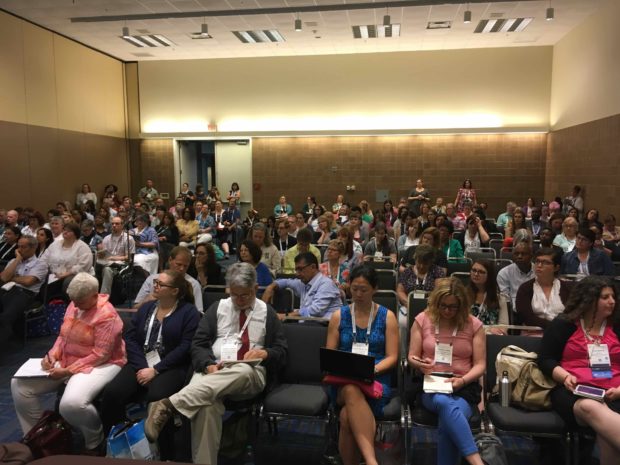
crowd of librarians sitting in conference hall at ALA annual 2018

“I am convinced that about one-half the money I spend for advertising is wasted, but I have never been able to decide which half.”

John Wanamaker, Quoted in Bible Conference, Winona Echos (1919)

It’s been 5 years since I attended an ALA Annual Conference. My interest in this yearly gathering of librarians from around the country has waned considerably in the last half-century as I’ve become more and more entrenched in the work of my own institution. That’s a story for another post. What I wanted to briefly talk about today was one aspect of ALA Annual that I miss: the PR Xchange Awards and the John Cotton Dana Awards. Both of these awards celebrate excellence in library communications efforts. The JCDs focus primarily on strategic communication and public relations, while the PRX celebrate singular promotional items. 

This year’s award winners highlight a few academic library projects. The University of Colorado Boulder Libraries’ “Culture Crawl” is a collaboration between eleven cultural and heritage organizations to highlight library spaces, services, exhibits, and local museums. It was the only college/university to win a JCD this year. The PRX awards had a much better showing from the academic side: Montana State University, Washington University, and James Madison to name just a few. 

While I love that these two awards bring attention to academic libraries producing remarkable content, I would love to see a separate award for excellent marketing, communications, and strategic outreach (and/or programming) for higher ed libraries. The needs of our communities and the best practices for reaching them differ just enough from our colleagues in public libraries to merit our own arena. Our audiences are captive and demographically narrower than the general population. Moreover, our ultimate ends lean more towards the specific (i.e., supporting graduation and retention) rather than the general (e.g., lifelong learning). Outreach to students, faculty, and staff is a different beast altogether than outreach to a local community. 

In developing a new award, the intent and structure of the ACRL Excellence in Academic Libraries Award (currently on hiatus) is a good place to start: how does communications and outreach connect with your library’s strategic mission and the mission of the college/university? Are you connecting the dots between (1) the skills, collections, and services that libraries provide; (2) our professional ethics; and (3) the goals of the housing institution? Outreach and communications success could be measured quantitatively or qualitatively, but would needs go beyond gate counts and feedback forms. 

All that said, perhaps a separate award isn’t necessary. I do enjoy seeing the wide variety of materials showcased by both the JCDs and the PRX. Either of those awards could create separate categories based on library types. I think what I want most of all is simply to see more academic library external commutations work. I know folks are out there creating remarkable content: let’s see it and celebrate it!

What I’m reading

Toward a Leisure Ethic by Stuart Whatley

“Every fleeting moment of our spare time is surrendered to the superficial offerings of the attention economy, all of it designed for addiction, the goal being to monetize people’s experiences rather than create meaningful ones. […] Many have extolled a leisure ethic, and none would say that time well spent lies in ambitious careerism or in drifting on a sea of addictive content. Most would agree that flourishing in time consists of free, active, thoughtful engagement with the world in accordance with one’s nature.”

The Ambitious Plan to Open Up a Treasure Trove of Black History by Erin Migdol

“The archive contains around 5,000 magazines, 200 boxes of business records, 10,000 audio and visual recordings, and 4.5 million prints and negatives that chronicle Black life from the 1940s until the present day.”

Writing for the Bad Faith Reader by Susie Dumond

“Not every book is for every reader.” Good advice for anyone creating art.

News from the garden

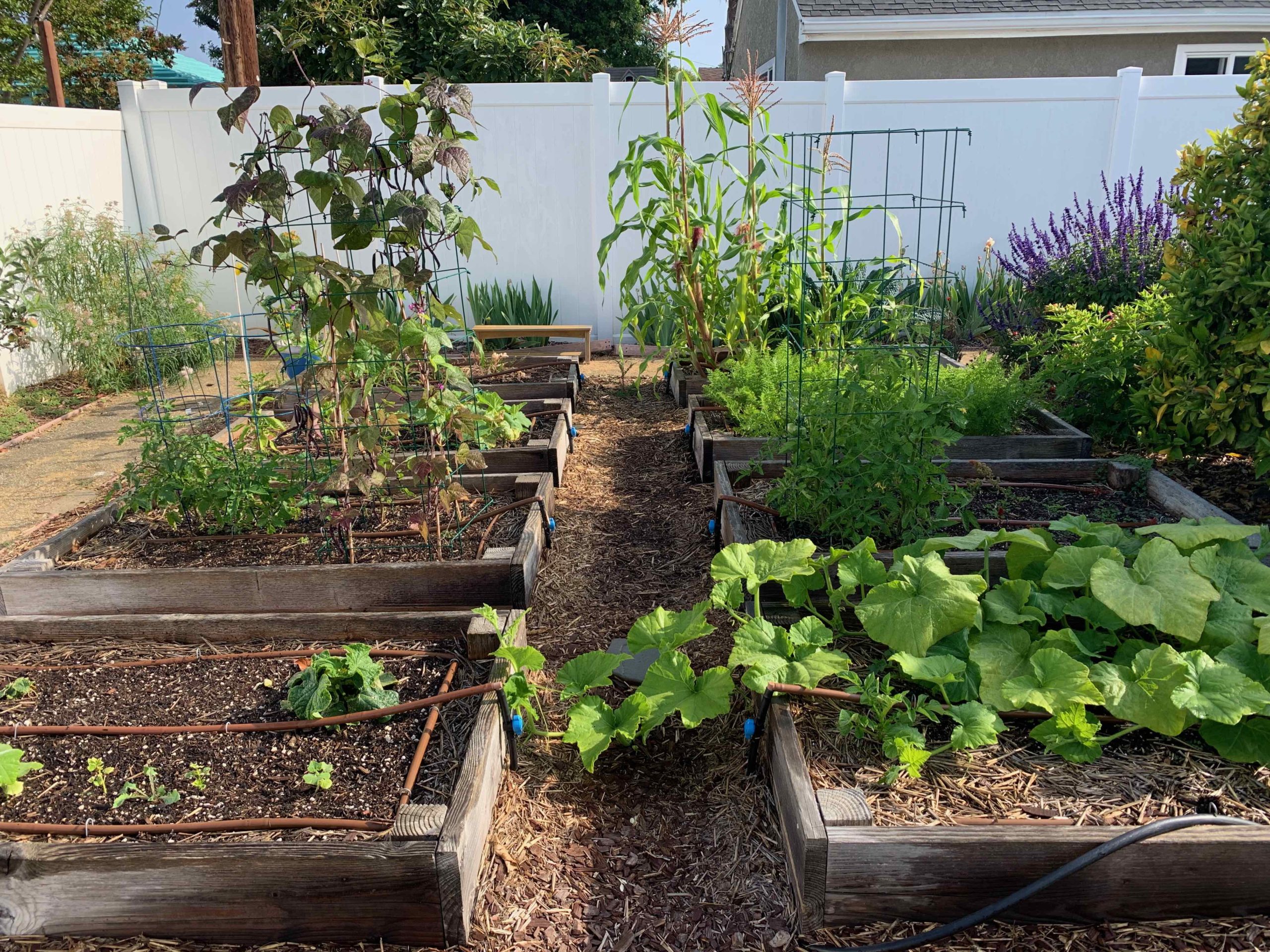
vegetable garden with squash vines, beans, and corn

The vegetable beds are [finally] in full swing. The vine in the foreground is butternut squash. And look! The corn made it knee-high before the Fourth of July! There are also tomatoes, peppers, and beans to be excited about. 

Links to the past

  • 1 year ago: Where the worm dieth not, and the fire is not quenched. “We give far too much weight to Twitter’s impact on social and political life and “the public square.” Collectively, we overestimate its influence, obsessing to an unreasonable degree over how it will react to our content, knowing full well that any storm we create today will be subsumed by next week’s hurricane of rage.”
  • 6 years ago: Life, uh, finds a way. Actually, now I would be OK with that.
  • 10 years ago: On ukulele calluses.

Overheard online

Rate limit exceeded.