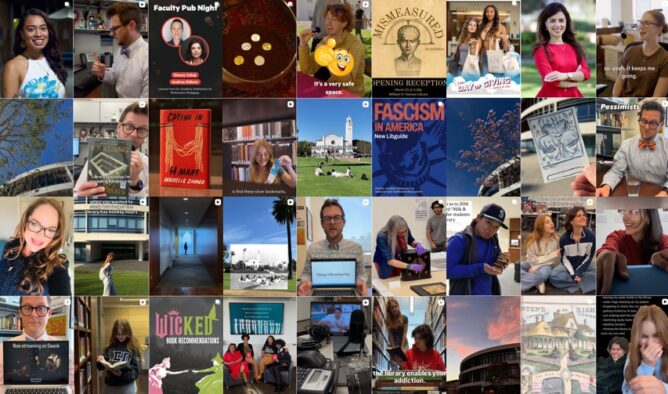
Engagement with my library’s Instagram account is up 1,285% since last year. The number of comments? Up 158%. The number of shares/sends? Up 1,786%. The number of saves? Up 107%. To put it in the words of my student assistants: fire. What’s more, that engagement on Instagram is seemingly translating to engagement with library spaces, services, and collections. [pause for effect]
There is little doubt in my mind that this is a result of an intentional shift in content strategy over the past two years: more video, more high-quality photos, more humor, more AI literacy content, and most importantly, more of the actual people of our community. You know what it’s not more of?
Fliers.
68% of the Instagram posts we’ve created since November 2025 (127 out of 186 total) include photography or video of LMU students, faculty, staff, or librarians. Only 4% of our Instagram posts might be considered “fliers” and yet… we still have high attendance at our events. Our last speaker event brought in more than 70 students and faculty. The remaining 28% of posts are mostly a mix of book recommendation carousels and photos of items from special collections.
None of these metrics matter though. Rather, they are indicators of a richer trend: that students are discovering a connection between what they see on our Instagram feed and how they experience the library.
Surveying library Instagram followers
Last year, I surveyed the library’s Instagram followers. My goal was to determine the effectiveness of our Instagram content, as measured by students’ perceptions and library usage. Among the 50+ students who completed the 3-minute questionnaire, I found three dominant themes in the responses.
Firstly, students view our content as informative and entertaining. This response was consistent, frequent, and tells me that our strategy to be an “edutainment” content provider is moving in the right direction. Secondly, students view our content as helpful, friendly, and welcoming, which speaks to our attempts to cultivate a sense of belonging among our students and reduce library anxiety. Finally, many students used words like “hilarious,” “cute,” “awesome,” “relatable,” and “unhinged” (my favorite), which speaks to the personality of our content, notably that our humor is a key differentiator.
When asked whether the library’s social media content positively affected their impression of the library, 96% said they agreed or strongly agreed. When asked if they had been inspired to use or visit the library as a result of something that was posted on the library’s Instagram account, 87% agreed or strongly agreed. In response to both questions, none disagreed (which is not too surprising given that the survey respondents were followers of our content and self-selecting).
Those results are encouraging, but the responses to the open-ended questions floored me. When I followed up to ask these students “What specifically inspired you?” I got things like:
- “Me and my friends see all the posts about library open house and as a result we attended all those events.”
- “I learned more about finding resources using the online website to improve the papers I write.”
- “A post about how to find resources and specifying primary and secondary sources.”
- “I saw the book “Crying in H-Mart” that the library recommended and that made me want to go to the library and get more books.”
- “The reels reminded me to use our research librarians as a source of support in my research.”
- “I saw people that are eager to help.”
- “I already go to the library pretty often, but some posts have alerted me to different events which I’ve attended, or to resources that the library offers. For example, the recent post about what items students can check out besides books was information I didn’t know.”
Respondents also mentioned our popular reading collection, the community they find at the library, postcards and magazine collections, the welcoming environment, film collections, are more. In short, we are teaching students about the library through Instagram and they are getting the message.
Here’s my hypothesis: Students who report that the library’s Instagram improves their perception of the library are also more likely to report feeling inspired to engage with the library. In some instances according to the respondents, Instagram content directly led to library engagement (e.g. attending an event, exploring a resource). It appears that Instagram functions as (1) a relationship-maintenance mechanism for library users, (2) a value-reinforcement tool, and most importantly, (3) a trigger for new or increased library usage.
Now, a more rigorous study would be needed to confirm this hypothesis and preferably one that is cross-institutional, but there is enough data here to confirm my belief that a well-designed, engaging social media presence can have a positive effect on library usage (at least among students who already identify as library users).
Strategy creates results: learning AND vibes
So my Instagram strategy for the past year has been to focus on creating content that I think our community would want to see. Students don’t use Instagram to find out about library services, collections, or events. They use Instagram to connect with friends, share their POVs, and to be entertained. The latter is an essential truth that I think many academic libraries fail to properly recognize when developing content.
If your content isn’t enjoyable, if it doesn’t spark curiosity and stop the scroll, is it even worth posting? Given that our FYPs are all algorithmically organized now, it’s a proverbial tree falling in the forest situation: if the algo doesn’t serve your content, no one will be around to see it.
That said, I always try to sneak in some teaching (h/t “camogogy” by Char Booth), even at the risk of “the bit.” My student assistants are no doubt annoyed at how often I say “yes, but what’s the library angle?” Whether it’s reminding students we close at 2 a.m. or mentioning how many databases we have (and that it’s OK to be lost at first), there’s almost always something to learn from the content we create.
Moving beyond metrics
Engagement rates are important sign posts, but they are not the end goal. If we want to measure the impact of our social media content (and it CAN make an impact), we need to rely more on qualitative instruments (my personal favorite is focus groups). How does it make our students feel? How does it influence their perception of the library? Too many studies in LIS literature focus on content analysis of academic libraries’ social media and never stop to ask: yes, but is it actually making a difference? (To learn more, come see my upcoming accepted paper at ACRL 2027: “You Sure About That? A Meta-synthesis of Academic Libraries’ Assessment of Social Media Use” on April 10 at 8:30 a.m.)
If I’ve learned anything in the past year, it’s that (1) yes, our social media content makes a difference and (2) we can measure it. So if you want to know what I’ll be working on next year… there it is!