According to the label, this “bone dry” riesling (0.3% residual sugar) was grown in soil rich with shale, gravelly loam, and clay with limestone. The first thing you notice on this wine (other than its slightly amber-straw color) is the nose. If it has nothing else, it has a bouquet enticing enough to draw you in: honey, mead, and apple. Medium to heavy bodied, on the mouth you’ll find lemon-lime soda and pear, with a tart, mineral and lemon finish.
“So it must be slow for you at the library in the summer.”
Everyone.
Let’s be clear. It is not slow for me during the summer. It has never been slow for me during the summer. As a department head and as an outreach librarian, the summer is the inflection point between the end of one academic year and the beginning of the next. It is the crest of two waves approaching each other from other sides of the time axis: from the past year moving forward in time is the wave of assessment, reports, and reflection. From the upcoming year moving backwards in time is all the necessary planning, strategizing, and worrying. And here I am in the middle, just letting the waves crash over me.
What I do to wrap up the year
Write my annual review, detailing my accomplishments in the areas of performance, research, and service
Pull together a list of all our programs, their costs, and attendance numbers
Pull and analyze a year’s worth of social media data. Create prez for leadership team.
Write the reports for any committees I chair (there are always at least two)
Submit data demonstrating progress my team made on the library’s strategic objectives
Begin the process of producing and publishing the library’s annual report to stakeholders/donors (finished in November)
Read and provide feedback on all my direct reports’ annual reviews
Archive all the things! (old working documents, photos, emails, etc.)
What I do to jump start the year
Set up all the Box folders and planning documents for next year’s events
Create a calendar that lists all the event production and communications milestones for all of next year’s events
Start the graphic design work for our 4 major tent-pole events/projects
Schedule and run planning meetings for fall’s earliest events
Estimate the total costs of next year’s events/outreach based on last year’s data
Try to map out (on my calendar) all my high-priority and/or new projects (so I don’t overcommit myself at any given time)
All of this work takes most of May through June to complete. All the while, there are still ongoing requests for support on other people’s projects, occasional events and tours to manage, and my own research. Summer is, in fact, the busiest time of the year. Granted, there are fewer interruptions, what with folks taking vacations and most of our faculty and students being away; tasks get done faster, making room for… more tasks. I could take it easier— rest on my laurels, slow down, and recuperate— but I would prefer to be busy now so that, come fall, I can switch to autopilot and ride the wave of the semester straight into winter break.
“Turning down additional work and obligations allows you to remain focused on your top priorities and the commitments you have already made. If you don’t do this, it’s easy to find yourself wrapped up in other people’s priorities […]”
“I’m not trying to pretend this is a novel idea. It clearly isn’t. But it’s a little like ordering a Wendy’s Spicy Chicken Sandwich on a roadtrip every five years just to remember it makes me feel like shit.”
“Customization can be surprisingly homogenizing. Everyone, or nearly everyone, is on Facebook: It is the most convenient way to keep track of your friends and family, who in theory should represent what is unique about you and your life. Yet Facebook seems to make us all the same. Its format and conventions strip us of all but the most superficial expressions of individuality.”
News from the garden
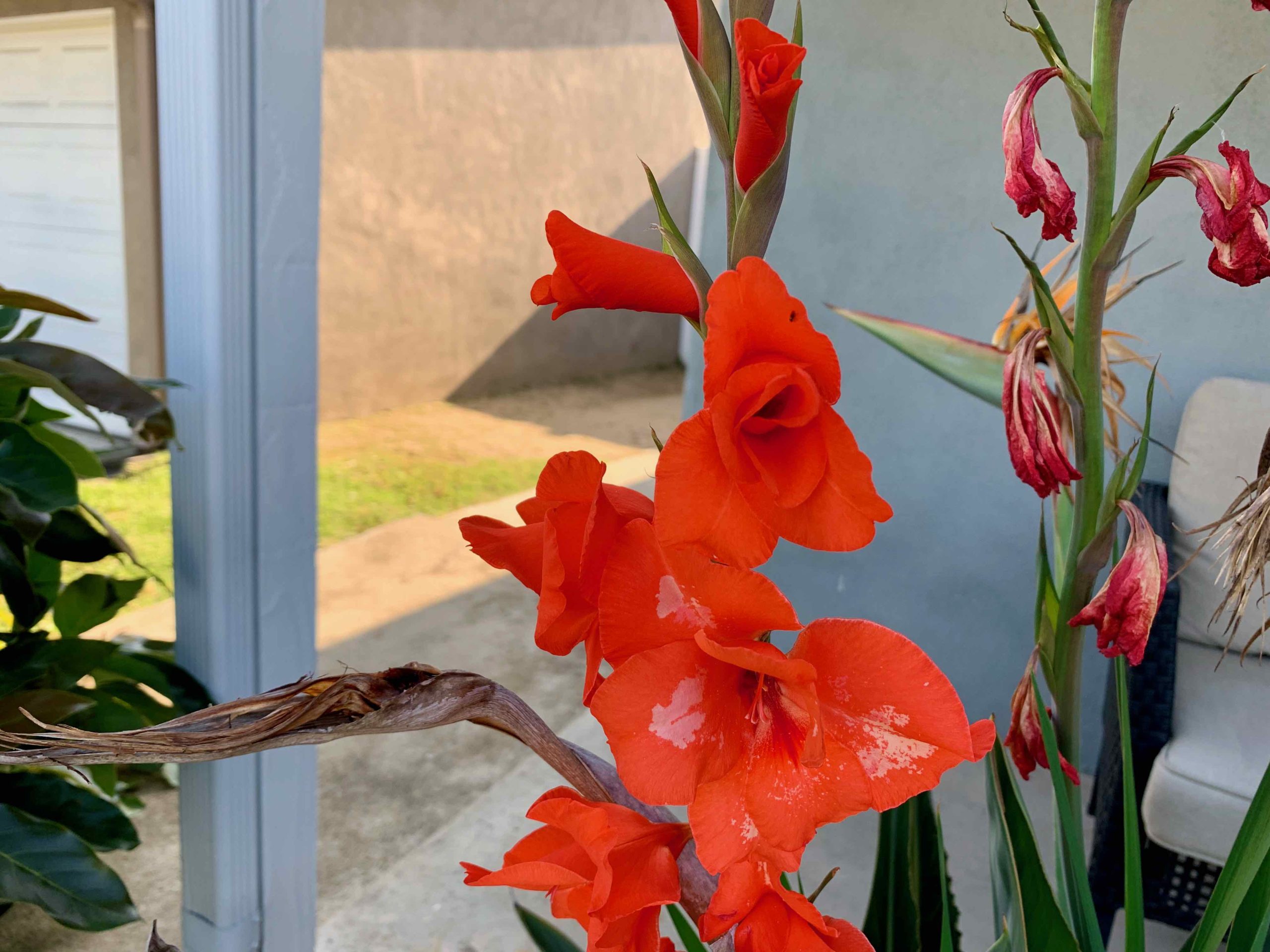
When we bought our house more than a decade ago, we didn’t realize there was a gladiolus bulb sleeping in our front flower bed. Each year, it has dutifully popped up in late Spring. This year however, a second one shot up just as the original one was beginning to fade.
Links to the past
10 years ago: On breaking up with libraries. “I’m not willing to be a martyr for my profession if it means compromising what I want out of life […]”
10 years ago: Bits and pieces. A snapshot of what library folks were talking about in 2013: the higher ed bubble, building repositories, and the information literacy standards.
10 years ago: Shokunin and the power of habit. “While I don’t know that I could ever attain a level of perfection equivalent to the idea of shokunin, through force of habit I can in the least put these same practices to work.”
Overheard online
@LPerenic: How on earth do you know that?
@bookstax: I am a librarian. If I don’t know it, I know where to look. (on Twitter)
I am a librarian. If I don't know it, I know where to look.
“It’s what we learn after we think we know it all that counts.”
Frank McKinney Hubard, Fairmount (Ind.) News, 17 Feb. 1913.
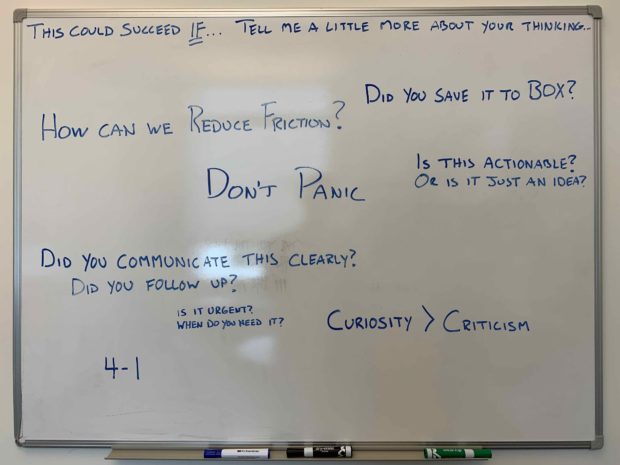
Just before leaving the office in March 2020, I wrote the following on my whiteboard: Don’t Panic. Those words would remain undisturbed for more than a year as we continued to work from home during the height of the pandemic. When I returned to the office in late 2021, I couldn’t bring myself to erase it. The dry-erase ink seemed physically and psychically etched into the laminated surface.
It has been a good reminder to keep things in perspective. Since that time, I’ve added a few more notes. These gentle nudges helpfully steer me toward more sensible actions, and serve as a warning light for when I’m drifting off track. Here is what I have as of this writing in May 2023, with brief explanations.
“This could succeed if…”
I have a tendency to immediately focus on everything that could go wrong, but the minute I begin thinking about what it would take to make something work, I instantly begin to find manageable solutions. Oftentimes, current resources (or lack thereof) don’t make those solutions possible, but outlining the steps from A to B is more than half the struggle.
“Tell me more about your thinking…”
Where “This could succeed if…” is something I tell myself, “Tell me more about your thinking…” is something I need to reminder myself to ask of others. Both statements help to curb my natural tendency to be a contrarian, seeking out the pitfalls in any idea.
“Curiosity > Criticism”
All things being equal, if I’m not sure how to respond to a request or a proposal, or if I don’t have an immediate answer, or if I’m feeling defensive, I find it’s always best to default to a curious response, instead of a critical one. Curiously opens doors in a conversation. Criticism closes them.
“How can we reduce friction?”
This is an important question for me when developing new programs or seeking out ways to improve existing programs. Oftentimes, the reason an initiative fails is something as simple as there being too much friction. For example, maybe the reason we get low response rates on some surveys is because it’s just too much work (just enough friction) to stop and fill out a form. How could we make that processes more integrated into existing habits or practices?
“4-1”
Anytime you are trying to balance “good vs. bad”, whether it’s compliments vs. criticisms, or pros vs. cons, or giving favors vs. asking favors, I’ve found that the 4:1 ratio is just about the right mix. Whether this has any relationship to the Pareto Principle, I couldn’t say.
“Did you save it to Box?”
Email 👏🏼 Is 👏🏼 Not 👏🏼 A 👏🏼 File 👏🏼 Storage 👏🏼 System 👏🏼. This past year, one of my employees left and we lost so much critical information about projects in-play because they used email to organize their knowledge. Whether it’s file attachments, advice, answers to questions, or communiques, none of that information is accessible if it’s stored in someone’s email account. The essential structure and protocols for email have not changed in 40 years. It was never built to be an information management system, and it has not improved in that regard (other than the fact we no longer have to watch our email storage limits).
“Is this actionable? Or is it just an idea?”
I enjoy starting new projects and experimenting with new technologies and platforms. But as I am fond of saying to my team: “we don’t need ideas, we need actions.” There are plenty of smart, creative folks working in academia, but not every ideas is worth pursuing (especially if you don’t actually have the resources). So when I’m presented with new ideas, I remind myself to pause before taking action. Maybe this is one of those “let it go and see if it come back to you” type of ideas.
“Did you communicate this clearly? Did you follow up?”
I overestimate my ability to communicate to others. I think most of us do. “It makes sense in my head! Surely, you see it the same way as I do!” Of course, this is rarely the case. So I need to remind myself to over-communicate when possible, and to follow up after folks have had time to sit with the new information.
“Is it urgent? When do you need it by?”
This was my most recent addition. MPOW operates on the hyperactive hive-mind model: no project planning or mapping out milestones. Just brute force emailing and DM’ing until the project gets done. This means I’m constantly getting random, unsolicited requests for support on projects that, until that very moment, I was not aware of. It’s frustrating to say the least. But I can mitigate some of that frustration by always asking whether the request is urgent, and/or when is it needed by. Unfortunately, the answer is usually “as soon as possible.” 🙄
“With AI there is no painting WITH light, as “photograph” means. There is the painting of light — illustrators, painters, sketches, collage… all of that. And that is cool.”
I’ve been on Twitter since 2007, and it hasn’t always been a delight, but the last year has been utterly miserable. Every time I log in, my outlook on the future of online communities plummets.
News from the garden
This spring, we have had an overabundance of cloudy, cold, and/or rainy days. Everything in my garden is growing slower than usual. This last week, however, the sun began to show its face. My trionfo violetto beans are finally starting to stretch their legs!
Links to the past
6 years ago: Peaches for me. This is what my peach tree is supposed to look like this time of year. I’m hoping my tree’s current lack of foliage is simply a result of this year’s overly wet and too-often cloudy Spring.
8 years ago: Tear down that wall. And John marched around the walls seven times. On the seventh time he took the holy sledgehammer and brought down the walls of the bamboo city.
10 years ago: All established institutions seek to persist. Telling a librarian that ‘this is the future; deal with it’ is not a wise strategy — because all established institutions seek to persist.
Overheard online
“Once again I’m going suggest that every person who wants to ban a book has to show knowledge of the book and its contents, preferably by being quizzed, without access to notes and/or a phone, by a librarian, in person, at the library. If you clearly don’t know the book: Fuck off.” (@scalzi on Twitter)
Once again I'm going suggest that every person who wants to ban a book has to show knowledge of the book and its contents, preferably by being quizzed, without access to notes and/or a phone, by a librarian, in person, at the library. If you clearly don't know the book: Fuck off.
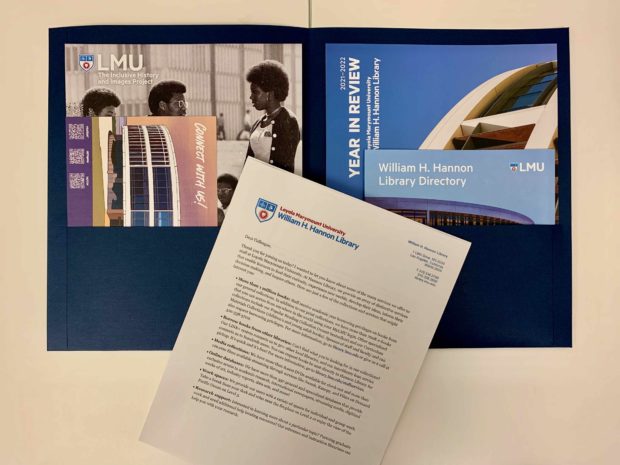
Before the pandemic, I was passionate about outreach to university staff at MPOW. Our weekly all-campus email used to include a photo of the attendees at the bi-weekly HR orientations (which of course used to only be held in person). The photo’s caption included the names of the newly onboarded employees. Using our online directory, I would pull the departmental and mailing information of the new folks and prepare a library welcome packet for each (seen above). It included: a custom letter outlining the various library services that might appeal to staff members, a copy of our latest annual report, a list of upcoming events, and various swag* items.
I would diligently send these packets through intercampus mail, being sure to track when and to whom I sent these off. Within 1-2 weeks, I would follow up via email to see if they had received the package (oftentimes, folks would contact me directly to express their appreciation) and offer to set up a tour of the library. But I didn’t stop there. I also set a reminder to follow up with each new employee one year later to see how things were going and if they had any new questions about using the library.
I was incredibly proud of this workflow and the connections it created, not just between myself and staff from other units, but also between those units and the library. COVID upended that entire project. HR stopped posting the photos to our internal all-campus newsletter (because who wants to see yet another Zoom screen shot). And even though new staff orientation have returned to in-person, the information about new employees is no longer published to the campus community.
Of course, I don’t put all my staff outreach eggs in that basket. My team and I host “VIP Staff Library Tours” twice a year, first during the Thanksgiving week and again during our campus staff appreciation week in the summer. We regularly invite staff to our events, and collaborate on various events with other units, such as our finals stress relief events, annual storytelling program, and one-offs like the Human Library and Long Night Against Procrastination. University staff continue to be an important connection point between the library and students.
Yet I miss the one-on-one outreach to new employees. I am still passionate about outreach to university staff, but I’ve yet to regain the momentum we lost post-2020.
*My student employees tell me that “swag” is no longer a cool word.
“Once these ideological views are coded in, users will not be able to exit to their preferred political values because they remain materially reliant on other lock-in features of the stack: like cash and health care data that are non-transferable.”
“It’s a library without librarians, consisting of content disembodied and decontextualized, severed from the meaningful work of authors, submitted to gullible readers. These systems are, in Alvarado’s words, ‘good at form; bad at content’.”
“People who habitually use Twitter will often make comments about Twitter as if it’s synonymous with lived experience.“Everyone is saying *this* about *that*.” Everyone? Like who? Someone you know? This line of questioning consistently produces the admission that ‘Everyone’ meant ‘The thread I scrolled through while on the toilet.'”
News from the garden
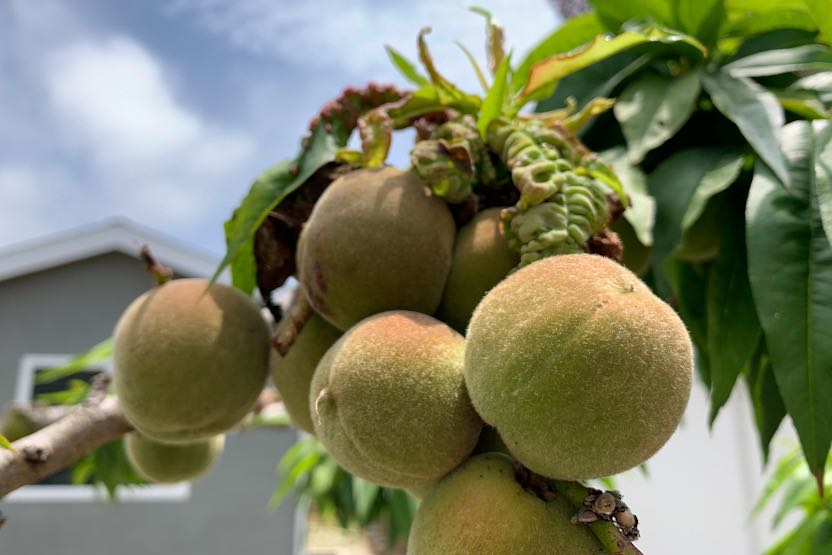
I’m worried about my peaches this year. To start, the tree didn’t produce as many fruiting stems as usual, and of those it did, they didn’t produce as many buds. Then as you can see from the image above, I got leaf curl (despite my diligent application of dormant spray in winter). I’ll still get a small crop, but I may not be canning as much as I did last year.
Links to the past
2 years ago: Garden seeds and room. I am well into midlife, and I’m still not sure that I’ve found “a task life-long given from within”, but I am lucky to have most of these others in my life.
7 years ago: The opportunity to breathe. There are a few stories that irrevocably changed my outlook on work and rest. This one I still think about frequently.
Elsevier: Spending your entire youth creating knowledge, then paying a billion dollar corporation to take it from you in exchange for career capital that you can then use to buy meaningless promotions from other exploited individuals.
The Crack-Up “Note-Books” (1945) by F. Scott Fitzgerald
At work, when there is problem that I feel I have the capacity to solve, I enjoy finding a solution. For me, “fixing things” is a natural impulse. I like being helpful. Acquiescing to that motivation, in part, got me to where I am today. But lately I’ve been stepping back, hearing myself say: “That’s not your job.” This voice often continues, transforming itself into a mantra: “A single person’s drive is not a sustainable solution to systemic problems. Don’t be the hero.”
This line of thinking feels particularly cruel to me. [It is not]. My core resists it. [That’s the problem]. Working in the service of others was one of the key factors in my decision to pursue librarianship. [Not a lie]. Yet these past three years have unceasingly kept my abilities up against the ropes, and the need to care for myself so that I can care for others is currently the predominating force in my struggle for balance.
So it was refreshing to stumble across this reminder from Fobazi Ettarh (via @CharlotteRock):
The problem with vocational awe is the efficacy of one’s work is directly tied to their amount of passion (or lack thereof), rather than fulfillment of core job duties. If the language around being a good librarian is directly tied to struggle, sacrifice, and obedience, then the more one struggles for their work, the “holier” that work (and institution) becomes. Thus, it will become less likely that people will feel empowered, or even able, to fight for a healthier workspace. A healthy workplace is one where working around the clock is not seen as a requirement, and where one is sufficiently compensated for the work done, not a workplace where “the worker [is] taken for granted as a cog in the machinery.”
In reading this paragraph I don’t see MPOW. I don’t feel like I need to work round the clock. I feel that fulfillment of my core job duties is valued. I feel sufficiently compensated and I do not [usually] feel like a cog in the machine. For the most part, MPOW values the quality of one’s work and the dignity of individuals over passion, and for that I am incredibly grateful. That said, the narrative of the passion-driven individual is always present, just beneath the surface. In my own soul, too, I fear. That is why I find it useful to resist being the hero.
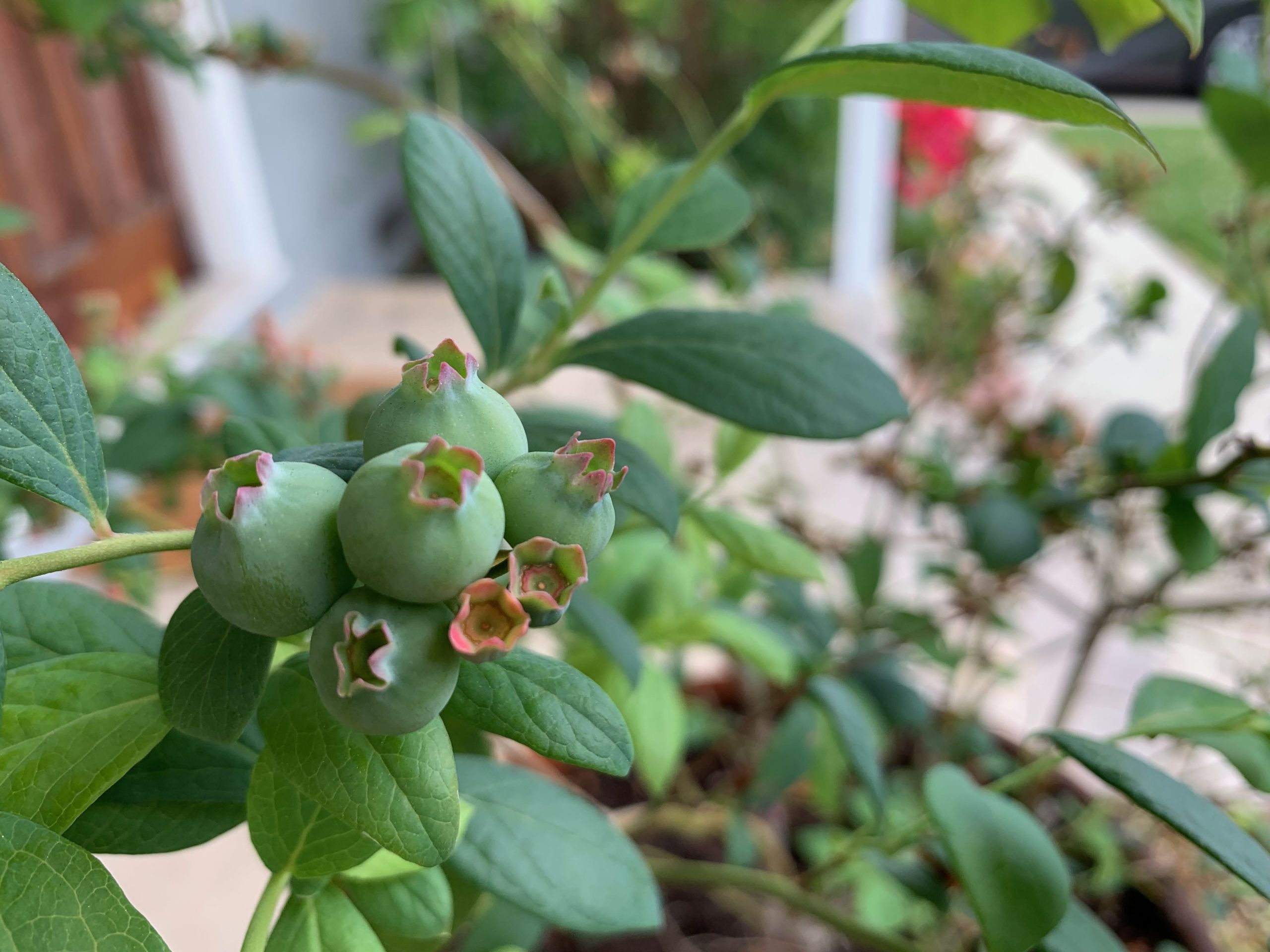
The blueberries are beginning to swell and ripen. Like most of my crops this season, the fruit yield and growth has been small due to an unusual lack of sunny days and the colder weather.
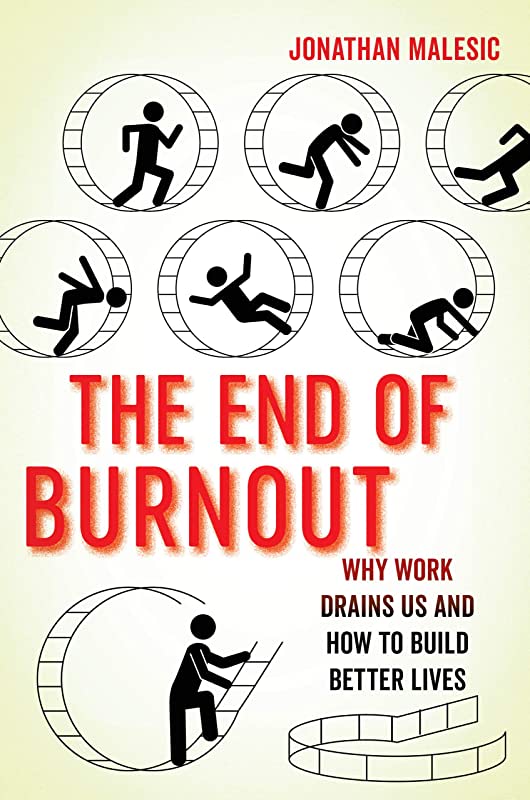
In The End of Burnout: Why Work Drains Us and How to Build Better Lives, Jonathan Malesic argues that burnout is a cultural phenomenon, not an individual one. Relying heavily on Christina Maslach’s definition of burnout, as well as her psychological instrument for measuring it, Malesic explores the history of burnout as a diagnosis, the cultural impulses that create and foster burnout, and ways we as a society can move away from it.
The first half of the book is dedicated to defining and delineating burnout as a concept and an experience. Briefly, burnout is caused by the gap between our ideals about work and the actual experience of work. For many people, work has been offered as a path toward self-actualization; but combined with deteriorating working conditions, the persistence of the Protestant work ethic, the idea of work as “a calling,” and the pull to always be mentally on-the-clock, work becomes a perfect recipe for burnout. It completely subsumes the self. “Work occupies not only our time by our psyches, too. We have no way to understand ourselves, and now way to express our humanity, except through our jobs. Even before we burn out, we lose much of our identity and our ability to live a good life.” (p. 132)
Malesic shows burnout to be a spectrum. He differentiates between those experiencing burnout without being “burned out” (i.e., they are still doing their job) and being fully burned out and incapable of work. The second half of the book explores remedies and introduces people who have found ways to escape the burnout cycle (spoiler: work less and stop rooting your self worth in your job).
It’s been a while since I read a non-fiction book with so much enthusiasm. And while I’m sure much of its appeal was due to my own feelings of burnout, I would recommend this book to anyone interested in refining their understanding of the “burnout epidemic.”
Every week, I set aside 1-2 hours for a weekly review. I look back over all the work tasks I’ve completed, see what’s coming up, and plan out the following week. This practice has helped me to maintain balance in my to-do list, reduce anxiety around the annual review process, and ensure that I don’t let important-yet-not-urgent projects fall by the wayside.
I first came across the practice in David Allen’s Getting Things Done. The weekly review is an essential part of my work-week. Without it, I’m given over to things that are current in the moment, “urgent,” or simply top of mind: none of which are accurate indicators for deciding how to prioritize my time. During the review, I look over (and record) the past week’s accomplishments, upcoming tasks, and the time I have available in the coming two weeks. And then like a puzzle, I see what work I can fit into the open slots in my calendar.
For me, the weekly review is a space for reflection. Moreover, it’s a productivity “hack” for reducing my anxiety about the annual review process. Like some academic libraries, our annual review process requires librarians to write a narrative detailing the past year’s progress in three areas: performance, professional development and research, and service. It can be an arduous and soul-devouring exercise. The weekly review, however, helps alleviate the pain somewhat. Having created a weekly record of my accomplishments, when it comes time to work on the annual review (and I begin work four months in advance) I have all the raw material already gathered.
It’s a simple practice that has a huge impact on my work-life balance. By ending the week with reflection and task-organization, I can go into the weekend, having left work behind me, care-free.
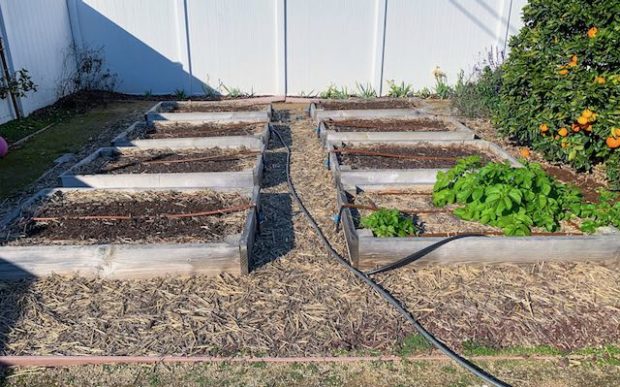
[image: The raised beds in my garden are cleared and ready for planting]
Each year, I say that I am not the type of person who makes New Year’s resolutions, but if I’m being honest, I do enjoy self-reflection and rethinking daily life. I can admit I’m a #goals junkie. That said, I like to think I’m more forgiving of myself at this point in life, even if I still struggle with the urge to take on too much.
For a number of years, I have been striving to do less, but to do those few things better. I’ve reduced my annual work goals, I’ve focused my quality leisure time to a handful of essential activities, and I’ve built some elaborate structures around my time. For the most part, it’s worked. We can talk about some of the downsides another time. For today, I want to focus on what practices I’m bringing into 2023.
Notebooks
I’ve accumulated a number of notebooks: moleskins, daily planners, quarterly planners, gratitude journals, habit-tracking journals, etc. I even have a custom journal just for gardening. All of them are sitting in a drawer having never been used; although, I’ve managed to stop myself from buying new ones. My goal this year is to fill all those notebooks.
Semi-planned weekends
My idea of a perfect weekend is one in which nothing is planned. Maybe I’ll go for a walk. Maybe I’ll play video games. Maybe I’ll just do maintenance around the house and yard. I use the long, unstructured time to recharge, but I also recognize the joy that comes in having something to look forward to each week, whether it’s an activity or a project. So my goal this year is to do some moderate planning for my weekends: maybe select one AM and one PM activity/project each day and put it on my calendar.
At work: skills
One downside of being in middle management is the constant pull toward “settling.” I could easily fill my day with meaningful tasks, including supporting the needs of my team and pushing along various projects. I could stay in this state for years, but I’m not content with that. I want to continue to develop new skills and improve nascent ones. This year, I’m focusing on advanced Excel techniques and (if time permits) intermediate Adobe Creative Suite work.
Having a theme
Inspired by CPG Grey, last year I selected a theme to help drive and direct my personal goals, leisure activities, and home projects. In 2022, my theme was “local.” While I didn’t finish everything I set out to accomplish, I am nonetheless amazed at how much I was able to do. This year, I plan to continue that method and select what I give my attention to according to a general theme. For 2023, my theme is “connections.”
Does this enlarge or diminish me
I love this question, which I first encountered in 4000 Weeks: Time Management for Mortals, of asking “Does this enlarge me or diminish me?” Often, I feel the urge to do something but default to doom scrolling or YouTube. But if I ask myself whether an activity enlarges me or diminishes me, I can perhaps select better choices. The same question might be useful in determining how I react to stressful situations at work.
Memory project
I’ve had this idea knocking around in my head for some time now. Like anyone, there are some memories that I recall often and others that arrive unexpectedly, perhaps for the first time in decades. Perhaps it’s a mid-life crisis thing, but I’ve been feeling the need to write all this down. So this year, I’m going to set up a digital space to organize and record as many memories as I have the time and ability to recall.
I think many will agree that the easiest solution is not always the best solution. Sometimes, a little resistance, a little friction, can be helpful. It can even be more human.
Take scheduling meetings. Occasionally, people will put meetings on my calendar. I’ll come into the office or back from lunch and there it is: a meeting invite tentatively waiting for me to accept its existence. Now, I know the sender had the best intentions. They would like to have some of my time and attention, so they looked at my Outlook calendar and selected a time they thought would be most convenient for the both of us. As I’ve noted before, the problem with this style of scheduling is that it assumes that just because someone is “free” that they are also “available.”
Unless explicitly instructed to, putting a meeting on someone’s calendar treats them as if they were a machine. Available or unavailable. Ones and zeros. What our calendars don’t take into account is all the unspoken baggage of the workday. How must preparation is needed for a meeting? How much debrief will this meeting require? What other things are happening that day that might be emotionally weighing on the you? How much mental bandwidth do you think you’ll have at the time of the meeting?
All of those things are lost in translation when simply “looking for an open spot” on someone’s calendar. Modern work culture has tricked us into thinking that shared calendars, with all their convenience, are a net good. They certainly have many benefits, but the ability to commandeer another person’s time is not one of them. By adding just a little friction to the meeting reservation process, in which the recipient has more agency (i.e. opt-in) in the selection process, we can treat our colleagues more like humans than machines.
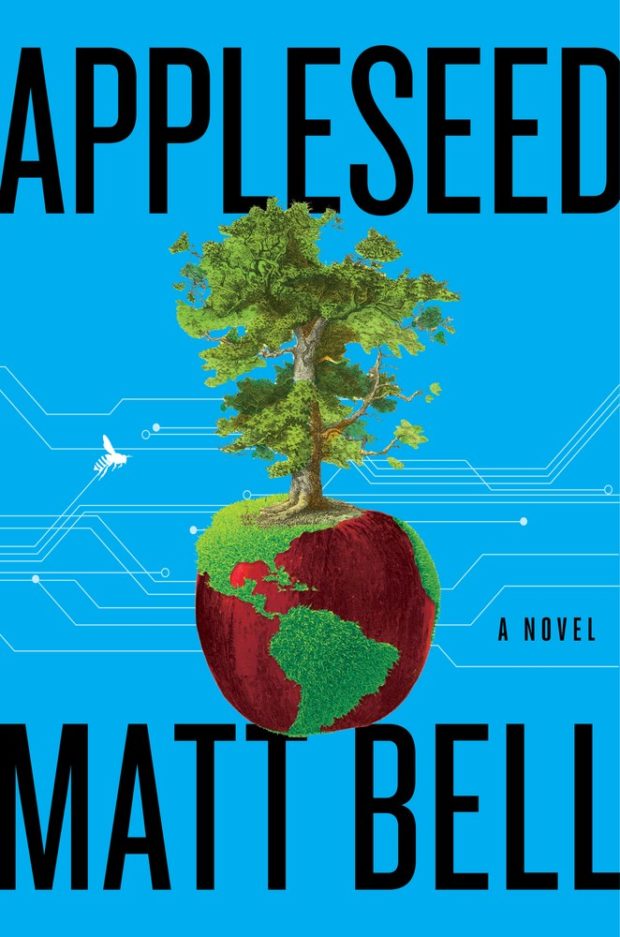
I wanted the first book I read in 2023 to be a work of fiction. I wanted to become immersed and nothing pulls me in faster than post-apocalyptic stories. Appleseed: A Novel by Matt Bell is a story that takes place across three timelines: one in the pre-industrial North American frontier, one in the near future following ecological collapse, and one in the far future after a continental-sized glacier has taken over North America. The characters that inhabit each of these stories are connected, not only by name, but seemingly also in spirit. Interwoven thematically (and sometimes literally) with their stories are the myths of Ancient Greece.
I found myself having to constantly slow down my reading. I wanted to speed through to see how it all ends: the plot driving above the speed limit. There are moments of wisdom throughout worth slowing down to catch. Each of the characters contemplating their place in nature, mirroring humanity’s greater relationship with the environment. It is a profoundly sad book: there is loss, betrayal, and deep love. We watch as the sins of the fathers and mothers, from one Fall to the next, move humanity and its ecosystem toward its inevitable end, each still seeking for some way to regain paradise.