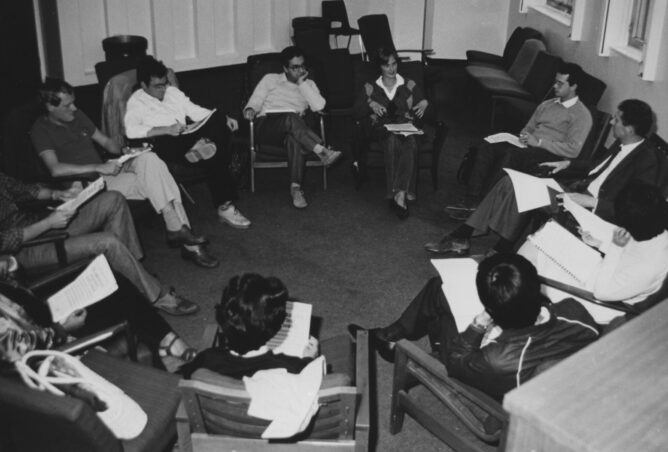
group of students sitting in a circle talking and taking notes

It takes a great deal of history to produce a little literature. Henry James, Hawthorne (1876)

I have been creating content for academic libraries for more than a decade. The definition of “content creator” has changed significantly in the past ten years, especially since the emergence of TikTok, and expanded to include a set of skills and activities that have exceed what I ever imagined I would be asked to do. To effectively market academic libraries these days, you need graphic design skills, video editing chops, an eye for photography, a knack for writing everything from blurbs to long-form reports, an understanding of how social media algorithms work, and web design. And that’s only including what’s needed for making digital content, to say nothing of print, or the more relationship-centered work that is generally considered “outreach.” The job is far more complex than one person would normally be expected to handle; though, out of necessity, many do. 

Perhaps this is why lately I’ve been dreaming of having a writers’ room to help develop library content. No, not a committee. This isn’t a service opportunity. Successful entry into the writers’ room would require some minimal level of aptitude, either in writing dialogue or developing storylines. So, still a low barrier to entry, but not necessarily a situation in which anyone would succeed just by virtue of being a library employee. And unlike a committee, the writers’ room would need to meet frequently, like two to three times weekly, to keep the creative momentum.

Suffice to say this isn’t a workflow that would likely survive in academia, but for a brief moment, I had something like this within my team. Last semester, our student employees would regularly hang out in our office suite before/after their shifts or between classes. Our conversations often found their way around to works in progress. It was in these moments that I could see the potential for regular pitch-and-workshop sessions around natal ideas. Many content ideas came out of these conversations (which, of course we didn’t actually work on until folks were back on the clock), driven by the diversity of life experiences, FYPs, and cultural references. Ideas that (1) developed at a faster pace and (2) I would never have developed on my own, or that would have seemed poor were it not for the enrichment of others’ perspectives. 

I want more of that.

What I’m reading 

🤖💥😳 Our Shared Reality Will Self-Destruct in the Next 12 Months by Ted Gioia: “At the current rate of technological advance, all reliable ways of validating truth will soon be gone. My best guess is that we have another 12 months to enjoy some degree of confidence in our shared sense of reality.” Well, that’s a fun thought. 

🍊💀🌐 President Trump Is Alive. The Internet Was Convinced Otherwise by Katie Rogers. This was my primary source of entertainment over the holiday weekend. It’s classic conspiracy theory, but the ride was delightful and I loved every minute of it.

🔧📞🪙 An engineer restores pay phones for free public use by Julian Ring. Please normalize this. Maybe if we bring back pay phones, we can all leave our phones at home more often. 

Links to the past 

  • 1 year ago: I was complaining about committees (Still am. See above) and urging for more intentional support structures for library outreach and communications work. 
  • 5 years ago: Nothing. Apparently I was taking a long sabbatical from blogging in 2020. Huh, wonder why.
  • 10 years ago: I was preparing to move to my new job at the William H. Hannon Library.
  • 15 years ago: I was in the middle of my MLIS program and looking to answer that essential LIS question: What is information?

Overheard online 

Thank goodness we’re going back to the good old times before… *checks notes* medicine @beyondmeat on Threads 

banner image: Seminar Group, c1981 (lselibrary on Flickr)
men and women painting on a landscape model

Lately, I’ve been thinking about how academic libraries structure their support for external communications. By “external” I mostly mean on campus, though sometimes this can include communications beyond campus, especially in the case of large state universities, R1 schools, and those with fundraising needs.

This isn’t a topic I have explored in the published literature yet, but I have been poking around library websites to see what info I can glean from staff directories and organizational charts. The various configurations for managing comms I have found generally fall into four types (I call them “tiers” below), though there appears to be little consistency beyond these broad categories. If a research study on this does not already exist, I would find it worthwhile to investigate it further.

In my experience, there are three factors that make academic library communications effective: consistency, strategy, and quality. That is:

  1. creating consistent messaging, branding, and tone; 
  2. developing strategic objectives and determining metrics of success; and 
  3. maintaining a high level of quality content production and execution. 

Of the four models for communications outlined below, only libraries in tiers 1 and 2 can guarantee high levels of all three factors. This is not to say that libraries within tiers 3-4 cannot be successful, but only that it is far more difficult.

Tier 1: The comms team

I suspect this mostly exists in R1 institutions or large campuses with multiple libraries. This is when the library employs an entire team of professionals to manage its communications needs. This might include a full time social media manager, graphic designer, writer, project manager, event manager, development officer, and/or videographer. Assuming that everyone on the team has the requisite skills and experience, this is the most desirable option and the one that securely enables consist, strategic, and high quality communications.

Tier 2: The comms director

Most likely to be found at mid-size university libraries. This is when you have a single full-time person entirely dedicated to communications. Their work might also involve planning and hosting events, and may vary considerably depending on (1) whether they are a librarian or staff and (2) whether they are housed within the reference department or administration. Assuming this person has the requisite skills and experience, this is also a desirable option, though without the balance and support of a team, there is the risk that either consistency, strategy, or quality could fail over time (also, burnout is a significant threat). Nonetheless, it’s a viable option.

Tier 3: The comms hat

Also may be found at mid-size universities, but more likely to be found in smaller colleges. This is when you have a full-time staffer who has been given the extra hat of communications. This might be a solo reference and instruction librarian, a collections librarian, or even a department head but it’s not their primary role. It’s almost a certainty that one of the three success factors will, out of necessity, fall by the wayside. 

Tier 4: The comms committee

This is the least desirable arrangement: communications by committee. While I don’t doubt there are some effective uses of this model out there, I would bet most are ineffective relative to the time and effort involved. This is when no one is in charge of outreach and it just happens depending on the variable bandwidth of the members of the group. Even with the best of intentions and structure, you cannot guarantee a consistent tone or level of quality. 

Finding the right fit

Academic library outreach and communications is a different beast than what one may experience in other types of libraries. For one, an academic library’s primary audience is a limited and captive one: students and faculty. Moreover, the distance, both physical and conceptual, that messaging needs to travel is relatively short. It’s in the secondary and tertiary audiences that variety comes into play: are donors a key demo? Campus senior leadership? State officials? How important is reaching the off-campus community? 

I don’t know what might be a best practice when it comes to structuring an outreach department, but I would venture that most libraries evolve from Tier 4 to Tier 1 over time, though most will never reach beyond Tier 2 due to staffing constraints. What I do know is that working in team environment has a number of benefits, including exponentially increased bandwidth, a mutually reinforced creativity engine, and a burnout buffer. However, it is essential that all members bring the requisite level of skill and experience to the table to make this work efficiently. 

Coda: The line between outreach and communications is a fuzzy one. The terms are frequently used interchangeably (guilty) but the latter has a much deeper and longer history of best practices, theory, and scholarship, mostly outside LIS. I think many libraries slap the term “outreach” on job descriptions and titles without giving much thought to the practical skills and knowledge necessary to make that work. That might be a topic for another time.

(header photo: library_of_congress on flickr)

three women working inside the fuselage of an aircraft

Folks often ask if it’s slower at the library during the summer. Yes, there are fewer students and faculty around. Many classes are online and the building is quiet for the first time in months. For the outreach team, however, we keep moving forward! From now through August, my team leans heavily into planning mode: outlining new project workflows, coordinating people and resources, preparing annual reports, and most importantly taking the time to update and fix what we couldn’t to pay attention to during the academic year. 

We have nine summer projects we’re hoping to complete before students return in August:

  1. Universal design for learning and events: Using principles from UDL, my team is looking for ways to improve our programs and events, making them more accessible for a wider range of attendees.
  2. Comms coordinating meeting: Our current way of coordinating external comms usually involves asynchronous messaging on Teams. We are looking at creating a more formal structure and timeline for both ideation and creation of materials.
  3. New event assessment tools: We just wrapped up a year-long pilot test of a new survey tool for library programs. Now, we need to take what we learned to create custom survey instruments for each event.
  4. New library merch: We’ve emptied out our library merch pile! It’s time to design and order new library branded merch for fall. 
  5. Update exhibitions guidelines: There are a number of recurring pain points in our hosted exhibitions program. I’m hoping updated guidelines with clearer expectations for our exhibitors will help.
  6. Improving partnerships protocols: We work with more than 40 partners throughout the year to host events and reach students. I’d like us to “up our game” by examining what makes a good partner, determining best practices, and updating our protocols.
  7. Banned books exhibit: Our banned books exhibit needs a refresher. We’re planning to update how we contextualize and talk about banned books beyond simply highlighting commonly challenged titles and listing annual stats.
  8. Student job descriptions: We’ve used the same job description for our department’s student workers for the past 5+ years, but the nature of the job has changed significantly since 2020. It’s time to rewrite the job description and possibly restructure the program.
  9. Finding the lights: A simple one, but one long overdue. For some of our larger events that happen in the evenings, we oftentimes need to adjust the lighting. Unfortunately, in our large, mostly open area building, it’s not always clear which switches control which lights. So break out the label maker! We’re going to finally figure this out.

There you have it. If you need me this summer, I’ll likely be plugging away at one of these projects above. For my academic librarian friends: what group projects are you and your teams working on this summer?

image credit: The Library of Congress on Flickr