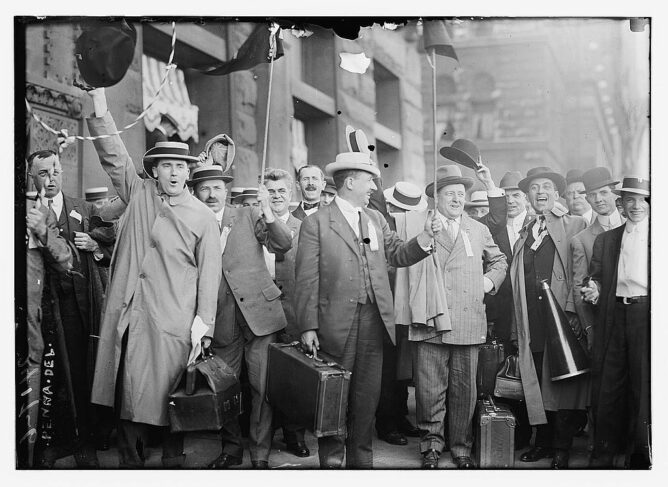
black and white photo of men in suits and pork pie hats celebrating

I’m at the point in my career where I can look back and see trends. I can vividly remember my early obsession with professional networking (2009-2011), the deep dive into critical pedagogy and instruction (2011-2015), the slow rise into outreach (2015-2017), and the crossroads that led to management (2018-present). Assuming I retire between the age of 60-65, this means I am just approaching the half-way point.

That’s a sobering realization.

And it leads me to think “what’s next?” I’ve been invited to apply for associate dean and AUL positions. I don’t yet know if that’s the direction I want to go. I’ve also considered stepping back from management to focus entirely on strategic communications and assessment. I’m not sure that’s a direction I want to go either. Frankly, I’m undecided on what my immediate next step is.

And that’s OK.

What I do notice, however, is an emerging fascination with the professionalization of outreach work. Within academic libraries, there are certain areas of work that are highly professionalized: e.g., reference and instruction, special collections, collection development, e-resources management, and systems. Basically, if there are multiple annual academic conferences dedicated to your line of work in libraries, you can consider your area to be highly professionalized. Also: multiple academic journals on the topic; multiple ACRL sections and interest groups; and professional competencies.

Outreach librarianship, as a stand-alone position, emerged alongside distance education librarians at the dawn of the internet in the 1990s and early 2000s. So in the grand history of academic librarianship, it’s one of the younger specializations. We do have academic journals and we just recently adopted professional competencies, but we are no where near the level of professionalization that, say, reference librarianship or collection development work is at. 

Outreach librarians take many forms: student engagement librarians, communication librarians, first-year experience librarians, various forms of liaison work, management, and instruction-adjacent positions. We also wear many hats, everything from program development and community engagement to marketing and social media strategy. Some are housed within reference and instruction departments, user services teams, or administration; others (like myself) are stand-alone departments. 

With what remains of my career, I think that I want to continue to professionalize the work that outreach librarians do. Developing standardized assessment protocols. Advocating for the hiring of uniquely qualified and skilled individuals. Championing the work of academic libraries that support notable outreach projects. I’m doing some of this work already as the Marketing Column editor for Public Services Quarterly and as a board member of the Library Marketing and Communications Group.

To those ends, these are some of the projects I’d like to work on:

  • Co-lead research that helps to further codify academic library outreach as its own LIS subfield
  • Help to build a robust set of outreach assessment tools
  • Form a community of practice around academic library ROI, storytelling, and communicating value
  • Formally highlight notable examples of successful academic library outreach (see also: RIAL)
  • Write a new book on academic library outreach 
  • Develop a new toolkit for library outreach (let’s bring back the ARL SPEC kits!)
  • Co-teach a course on academic library outreach 

Just to name a few.

Not that I have the time for any of this right now, of course; but as I look at the next 20-ish years of my career, I do want to start moving towards “the next thing.” And if that can be something that leaves an impact on the future of the profession by making it possible for more folks to pursue outreach librarian work along pathways that feel supported and well-trodden, that would be worth the journey.

banner image: Penn[sylvania] Delegation (via library_of_congress on flickr)

k-pop album covers and photographs

News and announcements

🎤🎵 Stanford’s East Asia Library hosted a Love Data Week event exploring how data shapes K‑pop. Attendees explored Stanford’s K‑pop collection, learned how fan engagement and music metrics are analyzed, and enjoyed games, snacks, and song sharing. Organized by librarians and staff, the program highlighted data’s role in global music trends. The event featured a performance by XTRM, Stanford’s competitive K‑pop dance team, exploring community through shared musical interests. There was “enough K-Pop data to seal the Honmoon” said the libraries’ social media coordinator, Carrie Gao.

🤖🤔 Last fall, Gleeson Library at the University of San Francisco convened a taskforce to consider how AI is impacting higher education and library work at their institution. They’ve issued their final report. They offer a set of values to support ethical, responsible, and transparent use of AI in library contexts, as well as links to what other AJCU schools are doing around AI. One thing that makes the AJCU’s distinct (aside from the obvious Jesuit connection) is their dedication to “discernment.” Reading this report suggests to me that the ACJUs collectively could lead the way in developing a more critical AI literacy framework. 

🎮💻 The University of Chicago Library has opened a Steam PC Cafe pilot as part of its “year of games” initiative. Students can play games like Portal, Terraria, Subnautica, God of War, Half-Life, and more. There are also inclusive titles for patrons with visual impairments; and students can recommend titles to be added.

🚧📢 The Carrier Library at James Madison University is going through a massive renovation. The new building is scheduled to open later this year. The communications in and around the construction work has been a master class in effective storytelling, community engagement, and external marketing (psst: there will be an article about this in the next issue of Public Services Quarterly).

📚☕️ The UC Boulder University Libraries is partnering with local independent bookstores to build a more community-centric collection. “The Boulder Bookstore has excellent expertise for curating books for the Boulder community. Every time I visit, I see things that I think we should have in the library collection” said Literature and Humanities Librarian Rybin Koob. In addition to bringing in diverse perspectives, this partnership enables the library to provide titles that connect to the specific interests of the local community— some of which may not be accessible through traditional acquisitions workflows. See also: Clarivate phasing out print book purchases and the closure of Baker & Taylor.

📜👩🏻‍🎓 The special collections team at WashU Libraries is soliciting nominations for a student public historian internship. Interns work with university archival collections “to assist with reparative description in finding aids and contribute to the WashU & Slavery Project digital archive.” There is also the possibility of developing a small exhibition. What a great opportunity!

🏛️💰 I did not have “Pam Bondi” and “Epstein” on my bingo card of announcements about library funding. But at Long Beach State, U.S. Congressman Robert Garcia presented the library with a $2.1 million check to fund their new Research Center and Special Collections Archives. The funding will help develop an expanded facility with an improved reading room and exhibition space.

Notable mentions 

Student at sewing machine

On social

I first saw the “This is who…” trend going around among coffee shops in early February. This is where you post baby photos of your staff with captions like, “This is who manages the money.” Academic libraries started picking it up in the last week, with prominent examples being University of Wyoming, Stockton, Fondren Library, Utah Valley U, and the J. Willard Marriott Library.

UC Santa Barbara took the lead from Wimbledon to do their own version of the  “mic’ed up” series here and here and here. They’re doing it with their service desk staff to highlight the variety of questions folks ask at the library. 

https://www.tiktok.com/@ucsblibrary/video/7610230151829409037

If you’re looking for a fun way to highlight the University Archives, take a cue from UF Libraries and create a video walking tour. Especially fun if you have some niche campus lore to share.

If you’re going to host a film competition, you best make sure the call for proposals is solid piece of video work. William & Mary Libraries read the assignment.

Here’s a motif I think I might ask my student workers to try out: playing hide and seek in the library as a means to promote various library spaces. I could see this working for any size library, from single-room to multi-floor! From Wayne State Libraries:

Finally, I thought this video from FSU Libraries promoting the library’s impact on student employees was extremely well done. Good lighting, voice over, talent, and editing. Obviously a social-first approach, one that I don’t always see in university fundraising videos.