page from Ortelius showing map of the world

News and announcements

🌏🗺️ The University of Michigan Library is posting a 3-part history about its copy of Abraham Ortelius’s “Theatrum Orbis Terrarum.” The library’s copy is rare, being one of the first forty ever printed. It’s also in need of extensive conservation and repair, the process of which UM is documenting through its news blog and on video. The book will be completely disbound and washed, old “fixes” will be unfixed and repaired, then it will be rebound in new material. It’s great to see the library documenting the entire process.

📻🎙️ Self-archiving is one of the greatest kindnesses you can give to future researchers. Carolyn Armenta Davis recently donated her collection of self-taped radio broadcasts featuring Black classical composers to Northwestern Libraries. Davis is a polymath whose curiosities extend to architecture, health research, and television news writing. This sentence encapsulates the impact of Davis’s decision: “Davis asked WEFM to her record her show, and she was able to retain the tapes because she was an independent writer-producer who had secured her own sponsor, Commonwealth Edison. Without that effort, this piece of radio history would have been lost.”

🤖💬 Brown University Libraries has created a critical AI learning community for students, faculty, and staff to explore and critique artificial intelligence technology and its implications for learners and researchers. It aims to center issues relating to justice and power, and is open to folks of various experience levels, covering conversations on practical skills, critical thinking, ethical issues, and social impact. Personally, I find these communities of practice to be more helpful than AI task forces that rush too quickly to codify policies and best practices– like building the ship while sailing rather than stopping to examine why we’re even on these ships in the first place.

📷🪏 Washington State University Libraries is participating in a series of events highlighting the history of farm workers in the Yakima Valley by creating a display of photographs from its collections for National Farmworker Awareness Week. NFAW is a week of action for university students and community members to honor farmworkers’ important contributions and to raise awareness about the issues they face. The library is working in collaboration with WSU CAMP, a federally funded program that helps first-year students from migrant and seasonal farm-working backgrounds transition to college each year.

Notable mentions 

Two pages from Matthew Paris OSB, Chronica maiora I, (ca. 1240 – 1255). The Parker Library, Corpus Christi College, University of Cambridge.

On social

“Iris” by the Goo Goo Dolls was one of my favorite songs growing up (as a teen, I was a massive Meg Ryan fan and the City of Angels soundtrack is nothing but bangers). So when the “Mom, what were you like in the 90s” trend started last month, I watched every single iteration. AcadLibs really took to this trend, using it as an opportunity to promote university archives and photos of really old tech (i.e., desktop PCs). Kansas State, Utah Valley University, Claremont Colleges Library, Loyola Marymount University, University of San Diego, Cal Sate LA, and Kenyon College, just to name a few. This meme was a perfect opportunity for university archivists to parter with the central university MarComm teams to collab over institutional history.

Purdue Libraries hosted a video contest that challenged students to answer the question: “What do incoming students most need to know about Purdue Libraries to succeed?” The winning video does not disappoint, showcasing real student anxieties and successes. You can also explore the other winners as well as past videos on Purdue’s website.

This photo carousel format from UC Santa Barbara is elegant and simple, utilizing high-quality photography and the experience of receiving an AirDropped photo. I could easily see other libraries using this format to highlight specific materials (e.g. “UCSB Libraries would like to share a book”). It might also work with silly, BTS photography (e.g. students doing weird things in library spaces), with each photo getting progressively weirder; or, posted chronologically to tell the story of a recent library event. 

Copley Library at University of San Diego took the “my boss left me a voice memo” format to promote a list of updates for their library, including spring break hours, an upcoming game night, and National Library Week. I hadn’t seen this meme in a few months, but it reminded me how useful it can be to highlight multiple announcements or CTAs in one video, even when those things may not have a single throughline.  

@copleyatusd

Check our website (link in bio) for up to date Spring Break hours. #universityofsandiego #librarytok

♬ original sound – Copley Library USD

Promoting VR creation services in a 2D medium like video is difficult, not just because you don’t get the full experience, but  because the learning curve for creating and utilizing VR is steep. But I love how Virginia Tech told a very human story of one student’s project. The video is just the right balance of enticing and informative, without being overwhelming. 

banner image: page from UM’s copy of Abraham Ortelius’s “Theatrum Orbis Terrarum”
Social media happens so fast. I mean, just a couple weeks ago, none of us had ever considered posting all our staff’s baby photos online. So in between the monthly “Recently in Academic Libraries” posts, I pull together regular updates on what AcadLibs are doing on social. Please enjoy these recent highlights. 

Good video = good vibes

I’ll admit that I’m a sucker for a well-thought out video. It doesn’t need to be complicated or even that “cinematic,” but if it’s obvious that someone put some thought into it, I’m impressed. Two videos recently caught my attention, one from Grand Valley State University Libraries and the other from Temple University Libraries. The GVSU video is just a simple exploration of colors in library spaces, but charmingly executed. The Temple video is more complex, but does a good job of keeping the viewer’s attention with a mix of close up and medium shots, with regular cuts. 

Things NOT to do in a study room

I think this trend started with university level accounts, but this is one from Pollack Library at CSUF of the better ones I’ve seen. It’s fairly easy to execute with invisible wipes/cuts between each shot, and an easy way both to highlight library study rooms and (in a kind way) poke fun at some of the ridiculous ways in which students use them. We did one at my library as well last month. 

@pollaklibrary

Want better study rooms? We do too! Support us during TitansGive on March 11th and help us upgrade our study spaces for all students. The donation link will be in our Linktree! Disclaimer: Please don’t try any of these activities in the study rooms lol

♬ original sound – CSUF Pollak Library

Days of giving

I’ve said it before: If you’re not having fun creating social content, you’re not doing it right. Butler Libraries is obviously having fun with their latest Day of Giving videos. Though I guess if you have a giant pool in your library, you’re already having fun. (See also the follow up.)

Let’s keep the fun going

I literally gasped at the second story in Hampden-Sydney College Library’s “Library Confessions.”

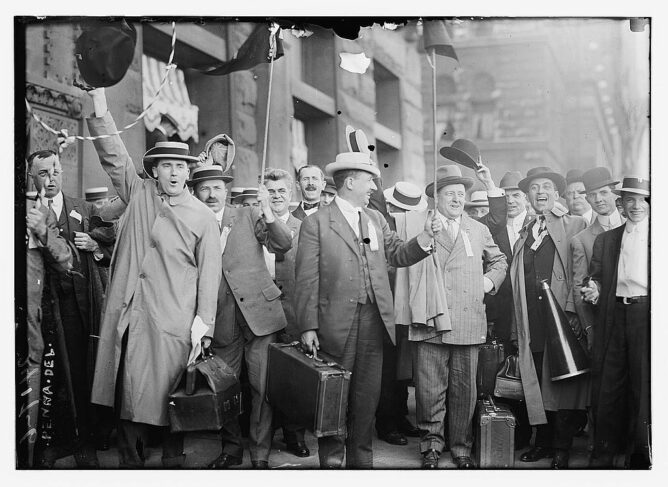
black and white photo of men in suits and pork pie hats celebrating

I’m at the point in my career where I can look back and see trends. I can vividly remember my early obsession with professional networking (2009-2011), the deep dive into critical pedagogy and instruction (2011-2015), the slow rise into outreach (2015-2017), and the crossroads that led to management (2018-present). Assuming I retire between the age of 60-65, this means I am just approaching the half-way point.

That’s a sobering realization.

And it leads me to think “what’s next?” I’ve been invited to apply for associate dean and AUL positions. I don’t yet know if that’s the direction I want to go. I’ve also considered stepping back from management to focus entirely on strategic communications and assessment. I’m not sure that’s a direction I want to go either. Frankly, I’m undecided on what my immediate next step is.

And that’s OK.

What I do notice, however, is an emerging fascination with the professionalization of outreach work. Within academic libraries, there are certain areas of work that are highly professionalized: e.g., reference and instruction, special collections, collection development, e-resources management, and systems. Basically, if there are multiple annual academic conferences dedicated to your line of work in libraries, you can consider your area to be highly professionalized. Also: multiple academic journals on the topic; multiple ACRL sections and interest groups; and professional competencies.

Outreach librarianship, as a stand-alone position, emerged alongside distance education librarians at the dawn of the internet in the 1990s and early 2000s. So in the grand history of academic librarianship, it’s one of the younger specializations. We do have academic journals and we just recently adopted professional competencies, but we are no where near the level of professionalization that, say, reference librarianship or collection development work is at. 

Outreach librarians take many forms: student engagement librarians, communication librarians, first-year experience librarians, various forms of liaison work, management, and instruction-adjacent positions. We also wear many hats, everything from program development and community engagement to marketing and social media strategy. Some are housed within reference and instruction departments, user services teams, or administration; others (like myself) are stand-alone departments. 

With what remains of my career, I think that I want to continue to professionalize the work that outreach librarians do. Developing standardized assessment protocols. Advocating for the hiring of uniquely qualified and skilled individuals. Championing the work of academic libraries that support notable outreach projects. I’m doing some of this work already as the Marketing Column editor for Public Services Quarterly and as a board member of the Library Marketing and Communications Group.

To those ends, these are some of the projects I’d like to work on:

  • Co-lead research that helps to further codify academic library outreach as its own LIS subfield
  • Help to build a robust set of outreach assessment tools
  • Form a community of practice around academic library ROI, storytelling, and communicating value
  • Formally highlight notable examples of successful academic library outreach (see also: RIAL)
  • Write a new book on academic library outreach 
  • Develop a new toolkit for library outreach (let’s bring back the ARL SPEC kits!)
  • Co-teach a course on academic library outreach 

Just to name a few.

Not that I have the time for any of this right now, of course; but as I look at the next 20-ish years of my career, I do want to start moving towards “the next thing.” And if that can be something that leaves an impact on the future of the profession by making it possible for more folks to pursue outreach librarian work along pathways that feel supported and well-trodden, that would be worth the journey.

banner image: Penn[sylvania] Delegation (via library_of_congress on flickr)

k-pop album covers and photographs

News and announcements

🎤🎵 Stanford’s East Asia Library hosted a Love Data Week event exploring how data shapes K‑pop. Attendees explored Stanford’s K‑pop collection, learned how fan engagement and music metrics are analyzed, and enjoyed games, snacks, and song sharing. Organized by librarians and staff, the program highlighted data’s role in global music trends. The event featured a performance by XTRM, Stanford’s competitive K‑pop dance team, exploring community through shared musical interests. There was “enough K-Pop data to seal the Honmoon” said the libraries’ social media coordinator, Carrie Gao.

🤖🤔 Last fall, Gleeson Library at the University of San Francisco convened a taskforce to consider how AI is impacting higher education and library work at their institution. They’ve issued their final report. They offer a set of values to support ethical, responsible, and transparent use of AI in library contexts, as well as links to what other AJCU schools are doing around AI. One thing that makes the AJCU’s distinct (aside from the obvious Jesuit connection) is their dedication to “discernment.” Reading this report suggests to me that the ACJUs collectively could lead the way in developing a more critical AI literacy framework. 

🎮💻 The University of Chicago Library has opened a Steam PC Cafe pilot as part of its “year of games” initiative. Students can play games like Portal, Terraria, Subnautica, God of War, Half-Life, and more. There are also inclusive titles for patrons with visual impairments; and students can recommend titles to be added.

🚧📢 The Carrier Library at James Madison University is going through a massive renovation. The new building is scheduled to open later this year. The communications in and around the construction work has been a master class in effective storytelling, community engagement, and external marketing (psst: there will be an article about this in the next issue of Public Services Quarterly).

📚☕️ The UC Boulder University Libraries is partnering with local independent bookstores to build a more community-centric collection. “The Boulder Bookstore has excellent expertise for curating books for the Boulder community. Every time I visit, I see things that I think we should have in the library collection” said Literature and Humanities Librarian Rybin Koob. In addition to bringing in diverse perspectives, this partnership enables the library to provide titles that connect to the specific interests of the local community— some of which may not be accessible through traditional acquisitions workflows. See also: Clarivate phasing out print book purchases and the closure of Baker & Taylor.

📜👩🏻‍🎓 The special collections team at WashU Libraries is soliciting nominations for a student public historian internship. Interns work with university archival collections “to assist with reparative description in finding aids and contribute to the WashU & Slavery Project digital archive.” There is also the possibility of developing a small exhibition. What a great opportunity!

🏛️💰 I did not have “Pam Bondi” and “Epstein” on my bingo card of announcements about library funding. But at Long Beach State, U.S. Congressman Robert Garcia presented the library with a $2.1 million check to fund their new Research Center and Special Collections Archives. The funding will help develop an expanded facility with an improved reading room and exhibition space.

Notable mentions 

Student at sewing machine

On social

I first saw the “This is who…” trend going around among coffee shops in early February. This is where you post baby photos of your staff with captions like, “This is who manages the money.” Academic libraries started picking it up in the last week, with prominent examples being University of Wyoming, Stockton, Fondren Library, Utah Valley U, and the J. Willard Marriott Library.

UC Santa Barbara took the lead from Wimbledon to do their own version of the  “mic’ed up” series here and here and here. They’re doing it with their service desk staff to highlight the variety of questions folks ask at the library. 

https://www.tiktok.com/@ucsblibrary/video/7610230151829409037

If you’re looking for a fun way to highlight the University Archives, take a cue from UF Libraries and create a video walking tour. Especially fun if you have some niche campus lore to share.

If you’re going to host a film competition, you best make sure the call for proposals is solid piece of video work. William & Mary Libraries read the assignment.

Here’s a motif I think I might ask my student workers to try out: playing hide and seek in the library as a means to promote various library spaces. I could see this working for any size library, from single-room to multi-floor! From Wayne State Libraries:

Finally, I thought this video from FSU Libraries promoting the library’s impact on student employees was extremely well done. Good lighting, voice over, talent, and editing. Obviously a social-first approach, one that I don’t always see in university fundraising videos.