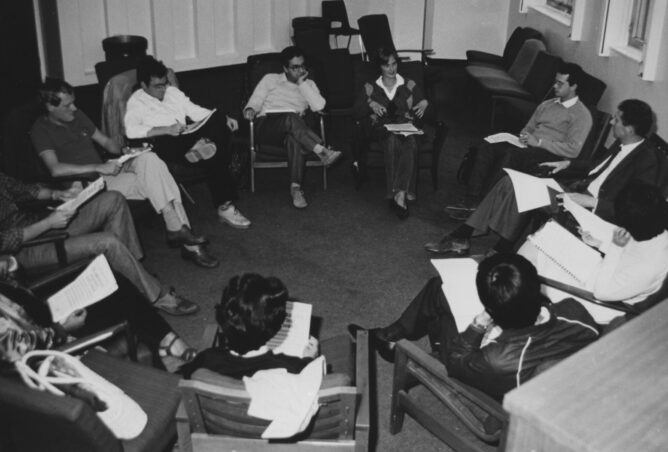
group of students sitting in a circle talking and taking notes

It takes a great deal of history to produce a little literature. Henry James, Hawthorne (1876)

I have been creating content for academic libraries for more than a decade. The definition of “content creator” has changed significantly in the past ten years, especially since the emergence of TikTok, and expanded to include a set of skills and activities that have exceed what I ever imagined I would be asked to do. To effectively market academic libraries these days, you need graphic design skills, video editing chops, an eye for photography, a knack for writing everything from blurbs to long-form reports, an understanding of how social media algorithms work, and web design. And that’s only including what’s needed for making digital content, to say nothing of print, or the more relationship-centered work that is generally considered “outreach.” The job is far more complex than one person would normally be expected to handle; though, out of necessity, many do. 

Perhaps this is why lately I’ve been dreaming of having a writers’ room to help develop library content. No, not a committee. This isn’t a service opportunity. Successful entry into the writers’ room would require some minimal level of aptitude, either in writing dialogue or developing storylines. So, still a low barrier to entry, but not necessarily a situation in which anyone would succeed just by virtue of being a library employee. And unlike a committee, the writers’ room would need to meet frequently, like two to three times weekly, to keep the creative momentum.

Suffice to say this isn’t a workflow that would likely survive in academia, but for a brief moment, I had something like this within my team. Last semester, our student employees would regularly hang out in our office suite before/after their shifts or between classes. Our conversations often found their way around to works in progress. It was in these moments that I could see the potential for regular pitch-and-workshop sessions around natal ideas. Many content ideas came out of these conversations (which, of course we didn’t actually work on until folks were back on the clock), driven by the diversity of life experiences, FYPs, and cultural references. Ideas that (1) developed at a faster pace and (2) I would never have developed on my own, or that would have seemed poor were it not for the enrichment of others’ perspectives. 

I want more of that.

What I’m reading 

🤖💥😳 Our Shared Reality Will Self-Destruct in the Next 12 Months by Ted Gioia: “At the current rate of technological advance, all reliable ways of validating truth will soon be gone. My best guess is that we have another 12 months to enjoy some degree of confidence in our shared sense of reality.” Well, that’s a fun thought. 

🍊💀🌐 President Trump Is Alive. The Internet Was Convinced Otherwise by Katie Rogers. This was my primary source of entertainment over the holiday weekend. It’s classic conspiracy theory, but the ride was delightful and I loved every minute of it.

🔧📞🪙 An engineer restores pay phones for free public use by Julian Ring. Please normalize this. Maybe if we bring back pay phones, we can all leave our phones at home more often. 

Links to the past 

  • 1 year ago: I was complaining about committees (Still am. See above) and urging for more intentional support structures for library outreach and communications work. 
  • 5 years ago: Nothing. Apparently I was taking a long sabbatical from blogging in 2020. Huh, wonder why.
  • 10 years ago: I was preparing to move to my new job at the William H. Hannon Library.
  • 15 years ago: I was in the middle of my MLIS program and looking to answer that essential LIS question: What is information?

Overheard online 

Thank goodness we’re going back to the good old times before… *checks notes* medicine @beyondmeat on Threads 

banner image: Seminar Group, c1981 (lselibrary on Flickr)
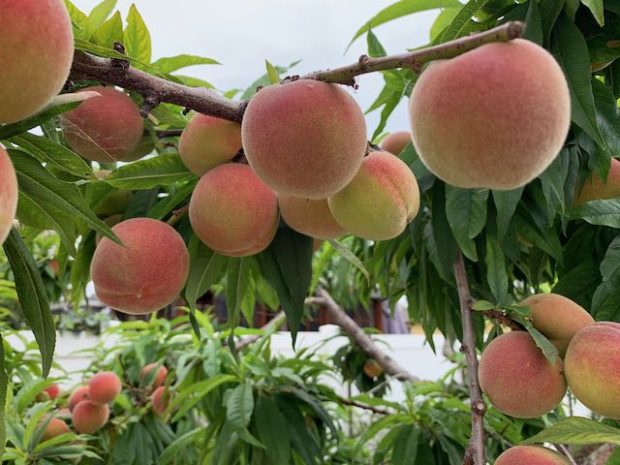
peaches on the branch

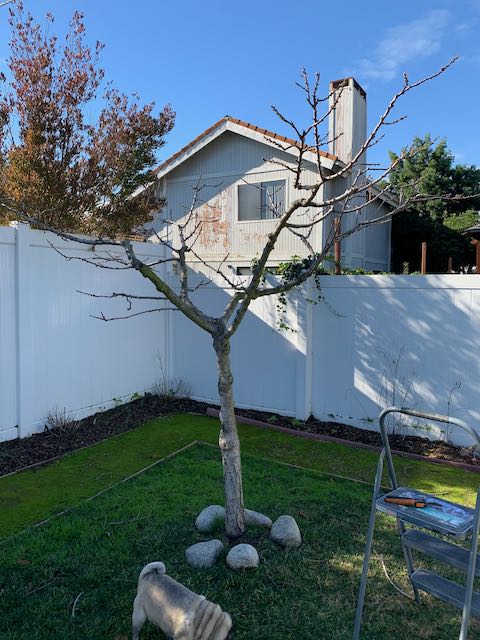
Pruning the peach tree in my yard is always a traumatic experience. Unlike the oranges, avocados, and apples in my garden, peaches require substantial work. I have to remove as much as 60-70% of the tree each year. You see, peach trees will only grow fruit on second year growth: older branches will not produce new fruit. Or to put it another way: more branches does not result in more peaches. If anything, it will negatively harm your crop by stealing energy from fruit production, weighing down the tree, and overcrowding the new branches. To help bring it to its fullest potential, you have to be brutal in your pruning practice.

This labor of love came to mind as I was working on an external relations piece for the library the past week. I was ruthless with my editing shears. It doesn’t make the experience any less difficult– to see all those darling branches on the cutting room floor–but the final result is a much tighter narrative that will allow it to bear the ripest fruit.

priced peach tree
The author’s peach tree, pruned and ready to bear fruit.

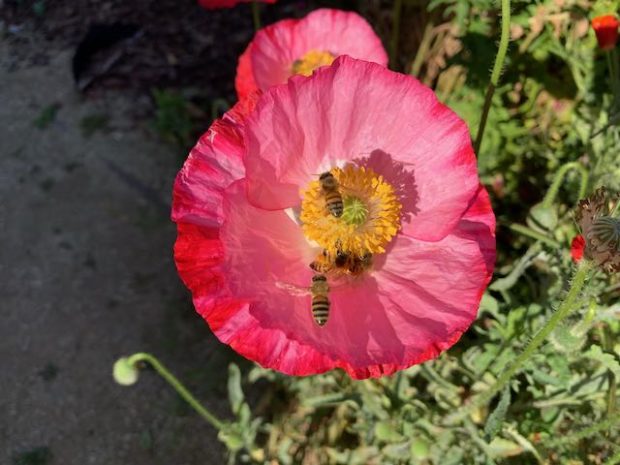
bees on a pink poppy

In the halcyon days of blogging, the link roundup was a delight to both the writer and the reader. For the reader, it was a chance to discover something completely new. For the writer, it was easy content. So here’s something that I hope we both will enjoy, dear reader: a small selection of what has caught my attention lately.

Matt Labash on writing

“All writing is an act of vanity. Which is why so many writers are insufferable jackasses.  Because writing requires you to essentially say to the world, which is constantly in motion: “I have something to say, you need to sit still and listen.”

“Don’t take yourself too seriously, but take your work very seriously. Care about the things you write about, even if they’re trifles. Because if you don’t, nobody else will.”

Source: https://mattlabash.substack.com/p/on-writing

The Atlantic on intensive parenting

“We need to normalize saying yes to prioritizing adult friendships and an adequate amount of sleep. We need to reassure one another—explicitly, publicly—that being a whole person is being a good parent.”

Source: https://www.theatlantic.com/family/archive/2022/05/intensive-helicopter-parent-anxiety/629813/

Kevin Kelly on life lessons

“Efficiency is highly overrated; Goofing off is highly underrated. Regularly scheduled sabbaths, sabbaticals, vacations, breaks, aimless walks and time off are essential for top performance of any kind. The best work ethic requires a good rest ethic.”

“Productivity is often a distraction. Don’t aim for better ways to get through your tasks as quickly as possible, rather aim for better tasks that you never want to stop doing.”

“Always read the plaque next to the monument.”

“To keep young kids behaving on a car road trip, have a bag of their favorite candy and throw a piece out the window each time they misbehave.”

“90% of everything is crap. If you think you don’t like opera, romance novels, TikTok, country music, vegan food, NFTs, keep trying to see if you can find the 10% that is not crap.”

Source: https://kk.org/thetechnium/103-bits-of-advice-i-wish-i-had-known/  

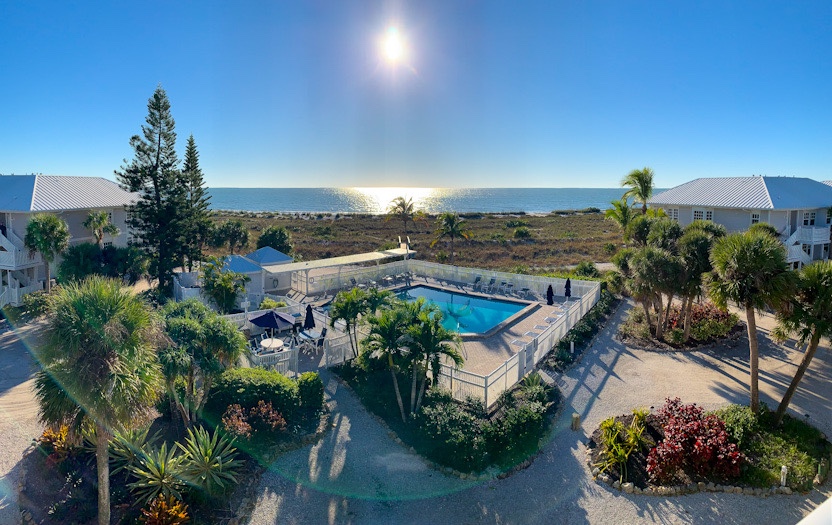
Panorama view of the beach, with pool at center and condos at left and right.

I did not imagine that I would leave almost half a year between posts. From the evidence of this blog, one might think that I did not succeed at my 2021 goal to write more. However…

Not only did I journal more in 2021 than in previous years, I also wrote three scholarly articles for publication (two of which have already been accepted and/or published) and one case study for a colleague’s monograph. Remarkably, I also read more books last year (25) than I have read in a single year since I was a graduate student more than a decade ago.

So I’m happy with the results from my 2021 future thinking and want to build on that success in 2022. I still plan to set aside time for writing projects– including journaling, blogging, and scholarly articles– and, more generally, working to increase my career capital through intentionally focusing on rare and valuable skills, notably: project management, workplace kindness, and draft-making. As time permits, I also plan to dive deeper into various systems for project management and Excel as a tool for maximizing PM success (I see Gantt charts in my future).

Ultimately, I want to position myself so that I can easily take on high-impact projects: program assessment, strategic planning, and relationship building (ie. with stakeholders), but doing more will at first require doing less, as well as continuing to be intentional about how I use my time (see also: time-blocking). Shutting down all but one of my social media profiles (and minimizing my use of the remaining one) helps, too.

Related:

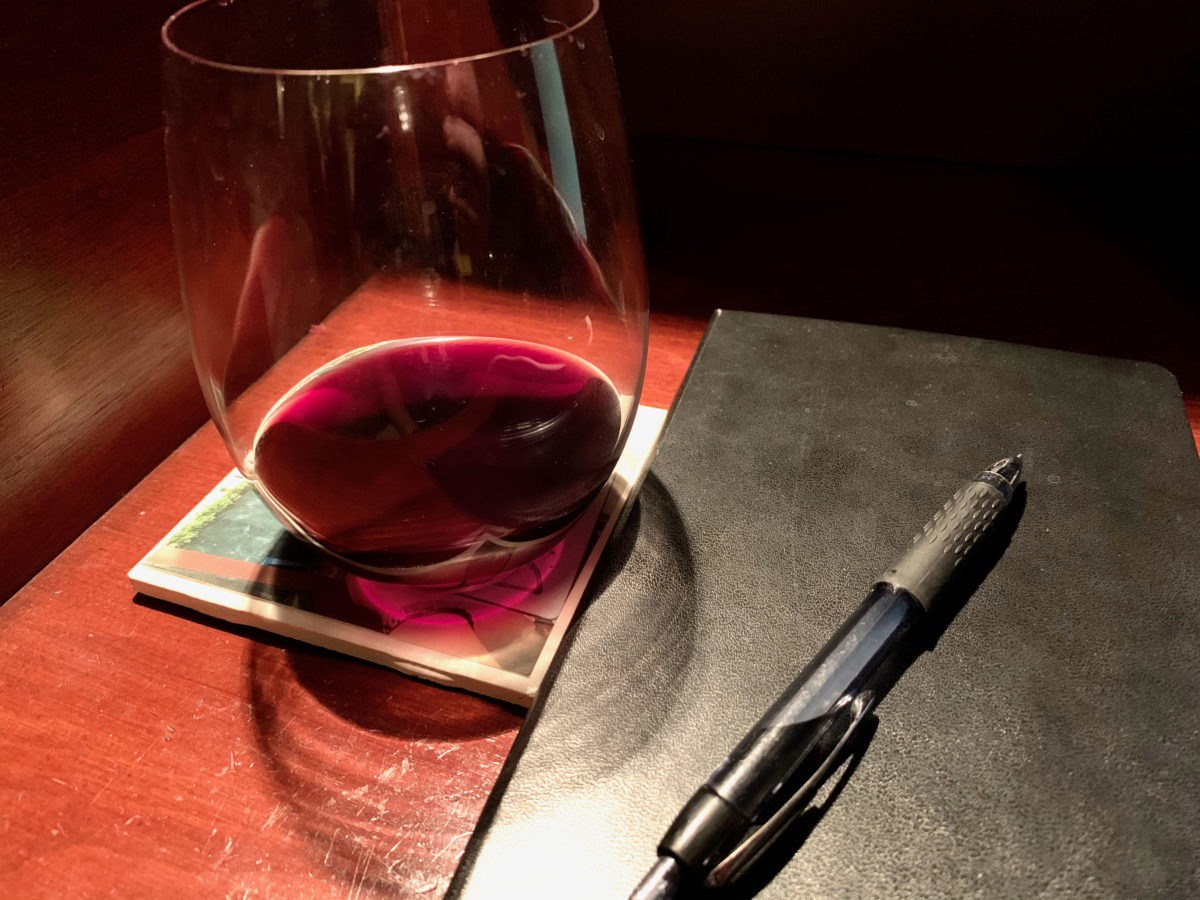
glass of red wine and moleskine notebook

Making new year’s resolutions seems more precarious than ever right now. And while I’m always reluctant to set goals that I know I’m likely to drop by February, the imperative to do better seems stronger for me than usual in 2021. I’ve been thinking about where I would like to be both in my career and personal life five years from now; and the path forward in both instances is through writing. So 2021 will be the year of journaling, *though writing, more generally, will be my focus.

I’ve set a personal goal to write in a paper journal each day. I’ve also set a professional goal to put aside time each M-F/9-5 for writing-focused projects: either writing that needs to be done on behalf of the library or writing for the publication of my own research in professional journals.[1] To meet this goal, I’ve time-blocked at least 1 hour of writing time each day in addition to time-blocking for research work.

I don’t have any restrictions on what I write: the goal isn’t to produce anything in particular. Simply, the goal is to put pen to page. Pixel to screen. Make the clackity noise.

[1] I’ve surveyed the LIS field and discovered that many of the scholars that I admire most publish approximately 2-3 articles a year. With that in mind, I have set myself to the same goal.

I am constantly tweaking my social media feeds mostly in an effort to limit what I see when I log into Twitter, Facebook, or whatever. A recent post by David Moldawer of Boing Boing gives some insight into the type of writing I try to avoid:

“The long tail of odd and authentic content is bigger than ever, but if you find your content the way most people do, through the algorithmically warped suggestions in your social media feeds, the stuff you stumble onto feels less like writing and more like wordage, a sort of tips-and-tragedies lorem ipsum.”

One of the first things I talk about in my library instruction courses for First-Year writing seminars is the difficulty of doing research in the Filter Bubble, but Moldawer’s post has me thinking about this from a different perspective: library marketing. I am not opposed to occasionally using popular forms of web writing (listicles, grabby headlines, lifehacking) to catch a reader’s attention, but I strive to create an authentic voice for our library, one that is friendly, energetic, and attentive to users’ interests and needs.

Which reminds me, I need to found out how the University of Iowa’s Special Collections’ team creates these awesome gifs. Also, you should follow their Tumblr.

And it’s at about 6 pages into this paper that I’m suddenly “not feeling it.” There is nothing worse than becoming utterly bored with a topic once you’ve passed the point of no return. I’m going to do my best to bring this to it’s so-predictable conclusion but am afraid the result will be absolute rubbish… sigh. Ok. Let’s do this.