I am interested in the future because I expect to spend the rest of my life in the future. Charles F. Kettering, quoted in the L.A. Times, 19 July 1939.
Recently, I was invited by Angela Hursh, manager of engagement and marketing for NoveList and owner of the “Super Library Marketing” blog, to give my predictions for what 2026 will bring to library marketing. It was an honor to have my thoughts sit alongside other notable library marketing folks. I was the only academic librarian included in the piece. So doubly honored! If you haven’t already, jump over to Super Library Marketing to read the entire post.
Library marketing in academic libraries shares some similarities with marketing in public libraries, but there are significant differences. Our audience tends to be more narrowly confined by age and education level. We also have high user turnover: as much as 25% of our population leaves each year to be replaced with new users. Moreover, we usually only get to work on building connections with them for 2-4 years before they cycle out of our system completely. On the flip side, they can often function like a captive audience, depending on how integrated the library is with the curriculum. The communication landscape of a university is also dense, with plenty of opportunities for cross collaboration between departments.
All this to say, my additions to Angela’s piece might benefit from some additional context, especially since I came at this from the perspective of an academic librarian. So below I’ve included my quoted sections of the original post, followed by additional commentary (that wasn’t included in my original contributions but were certainly in the back of my mind while writing them).
Prediction: “In 2026, social media will be more about connection than reach.”
My Quote: “It will be a challenge for libraries to engage with users who rarely step beyond those private spaces, [e.g. groups chats and DMs]” states John. “Combine this with algorithmically defined feeds, and now you have a situation where a library’s content may never get any eyeballs unless it can simultaneously ‘stop the scroll’ and be worth sharing. I expect this will drive library marketers to create content that is intentionally designed to be shared across platforms (i.e., there’s some social benefit to the user if/when they share the library’s content), but that may also leave marketers in the dark concerning assessing the true impact of any digital campaigns.”
Commentary: Being successful on social media is more difficult than it used to be. Platforms no longer offer chronological feeds. The FYP is the new default. The only way for me have a chance at getting student eyeballs is to (1) create content that impresses the algorithm or (2) create content that has a high benefit-to-share ratio. The second of these is easier to create, though perhaps more limiting. Libraries that can achieve 1 and 2 simultaneously will be the most successful and it’s one of the reasons I rely on shares/sends to measure social media success. However, once it leaves the platform (e.g. gets shared to the group chat), it becomes impossible to track so the true extent of the word of mouth will be unknown.
Prediction: “Libraries that invest in marketing as essential infrastructure, rather than an add-on, will be better positioned for sustainability and trust.”
My Quote: “Smarter marketing, building connections, hyperlocal relevance: none of this will be possible without content strategists and content creators who have the right skills, experience, staff, and equipment to bring this to bear,” contends John. “It behooves library administrators to commit when it comes to external communications. It’s not enough to have an amazing library. You’ve got to keep selling it, over and over and over and over again.”
Commentary: If you build it… they probably won’t notice. It is the year of our lord 2026. We should not be having to explain why marketing, communications, and outreach are essential functions of the academic library. The pitfall that I see most academic libraries fall into is that they assign these essential functions to non-professionals. A committee, student employees, the newest hire, the most eager employee. Not that these folks are not capable, but quality marketing and strategic outreach comes from experience and skills. The library’s place within the campus ecosystem and student life is not a given. We need skilled storytellers who can capture hearts and minds. So if you want to succeed in this area, hire and staff like you mean it.
Prediction: “The most effective library marketing in 2026 will make people feel seen, supported, and welcome, not just informed.”
My Quote: “The media success of libraries like Columbus Metropolitan Library and Los Angeles Public Library is going to drive more libraries to invest in creative storytelling,” he says. “The libraries that can muster the right amount of creativity, leadership, and resources will focus on slow storytelling (think: Craighill or Planet Money) and serial content (think: “Roomies” by Bilt or “Chit” by Jay Renshaw). This will likely drive libraries to mimic each other on social, so the challenge for any library content creator will be to find a way to rise above it all and deliver content that is both uniquely entertaining and directly relevant to their communities.”
Commentary: Your website is not a bulletin board. Your e-newsletter is no a bulletin board. Social media is not a bulletin board. Our library users and our staff need to be the center of our messaging strategy. Whether it’s through highlighting library fans or turning your staff into main characters, folks are looking (1) to be entertained and (2) to form parasocial relationships with the organizations they love. As library marketers, we are tasked with wooing our audiences through connection, understanding, and just the right amount of spice. You can’t “template” marketing. If it were that simple, companies would not pay six figure salaries to content strategists and “storytellers.” If anything, using templates or following a formula is exactly the opposite of effective marketing because the entire point is to rise above the noise in order to connect what your users want to what you have to offer. Each library has unique campus communities to appeal to, so invest in both taking the time to understand those communities and hiring folks best skilled to foster those connections through creative outreach.
What I’m reading
The Age of Academic Slop is Upon Us by Seva Gunitsky: “It seems people were using AI to generate terrible manuscripts and then shotgun-spraying them across the academy with little regard for quality or fit […] And these papers won’t be bad. They’ll be narrowly useful, methodologically sound, and for the most part not very interesting.”
Behind the Scenes with Milwaukee Public Library’s TikTok by Hannah Arata: “Each video, whether it takes 10 minutes or seven hours to create, becomes an invitation for someone to rediscover their library or step inside for the first time. As MPL continues to experiment and learn from its data, staff are proving that libraries can be both rooted in tradition and innovation.”
We’re not nostalgic for 2016 — we’re nostalgic for the internet before all the slop by Amanda Silberling: “As AI increasingly encroaches on everything we do on the internet, 2016 also represents a moment before The Algorithm™ took over, when “enshittification” had not yet reached the point of no return.”
Links to the past
- 1 year ago: Duke University’s Lilly Library was getting “cored like an apple.”
- 5 years ago: My library was winning the ACRL Excellence in Academic Libraries Award!
- 10 years ago: I started task blocking my days. I still do this and it’s the only way I’m able to get as much done during my week as I do.
- 15 years ago: I was singing the praises of online education. If I only knew what the next decade would bring.
Overheard online
Recently I logged in to the photo app and the short form videos were ALL about #Godzilla. Hadn’t seen anything related on that app in a while so who knows why, but I am happy about the result. @Anneheathen on Mastodon
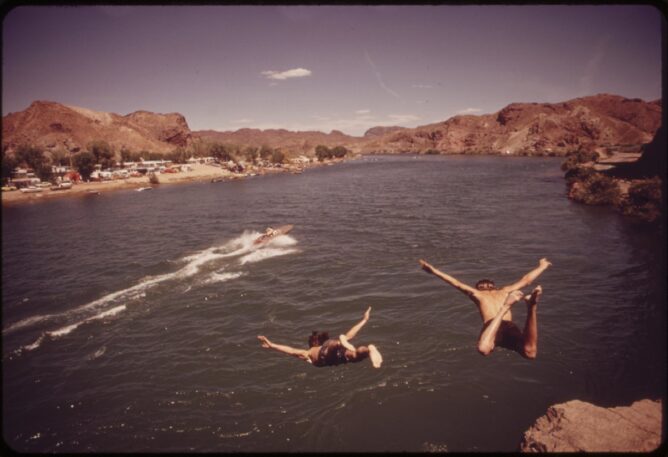
banner photo: Diving into the Colorado River at “Parker Strip,” a favorite swimming spot of southern Californians and Arizonians, April 1973 (source: U.S. National Archives on flickr)