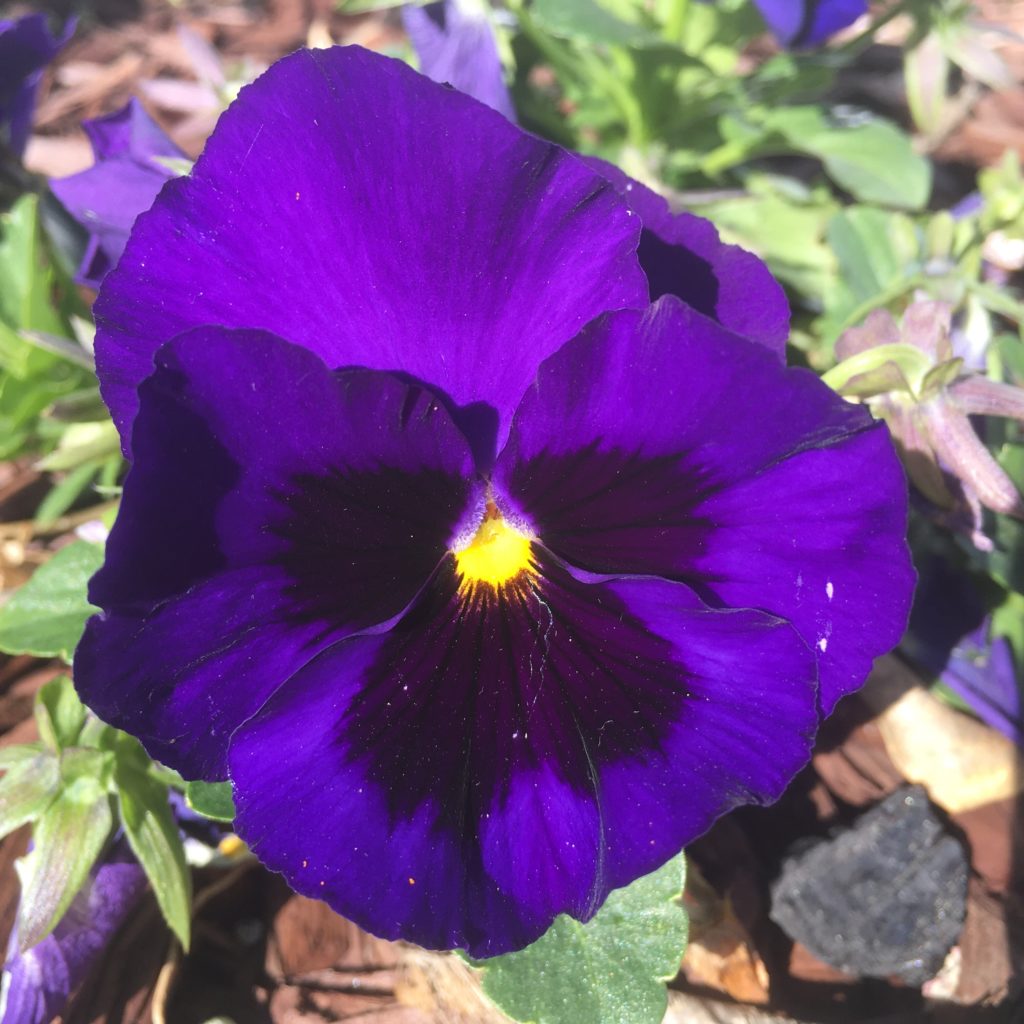
Purple pansy from my garden.

This year, I want to change the way I experience the internet. In both architecture and rhetoric, we talk about ductus: simply put, the way in which the pathway influences our experience of the content. Imagine entering a cathedral and moving from a small, enclosed narthex to the nave and into the crossing. The experience of the space is very different than if you had entered from the porch’s side entrance.

I want to forcibly change my experience of the web by building a new path. A slower path. A quieter path. At the risk of sounding like an aging technologist who first surfed the World Wide Web from a dial-up modem (which I did), I want to recreate to the extent possible that experience. Fewer inputs. Smaller circles. Less connection.

Social media offers us a great, almost irresistible level of connection, but it never stops moving. I want to find space to disconnect, reflect, and muddle about. I want richer content with less focus on personal brands. I want cool takes. I want the ability to disconnect for days without consequence. I don’t want the pressure of real-time information.

These are some of the initial steps I’m taking to create a quieter internet for myself:

  • remove social media apps from my mobile device
  • stop posting to social media (I may allow myself 2-3 tweets per week)
  • set up an RSS reader on my desktop machine
  • subscribe to a small, manageable selection of feeds
  • when I feel the urge to surf, scroll or wander, start at metafilter, LibraryThing, or a random wikipedia page
  • spend time curating my bookmarks (possibly revisiting old ones)
  • share my thoughts and findings here

Some say the heyday of blogging is over. Google Reader is dead (may it live on forever in our memory) and many of the great blogs of the late aughts and early teens have gone silent, but it is still possible to find quality, long(er)-form content out there. This new year, I want to go back on an RSS-based diet.


If libraries simply report outputs as we always have, we run the risk of someone else dictating our worth.

Meredith Farkas, “Your Library’s Story

I think about this potential pitfall frequently. Even more so, I worry about how relying on traditional metrics creates eyes-glazed-over reactions from stakeholders who already struggle to remember how libraries’ play a necessary and invaluable role in higher education.

Libraries are essential to the educational mission of the university, but we have become so very efficient at integrating into that mission that we’ve become invisible. While I knee-jerkingly resist worn out tropes about librarians, I sometimes find it valuable to play on these archetypes in my outreach and communications work.

Over the centuries, we’ve gotten pretty good at developing workflows that maximize our ability to support IHEs. Libraries and the work they do are certainly not without problems, but considering all that we do for our students and faculty, especially in the areas of collection development and research support, we are a damn fine and extraordinary machine. That outputs that we’ve traditionally reported to stakeholders were, for decades, the simplest distillation of an extremely complex operation.

But these outputs were predicated on a false ideal of “growth.” Academic libraries today don’t need to show evidence of growth as much as they need to show evidence of enrichment. As Farkas says, we need to showcase “how patrons use the library and its effect on their lives.” And we need to drive that message home.

And realize that one person cannot be all outreach, even though they may have the title. It takes a concerted effort on the part of many people at all levels to make outreach a success at any institution, never forget that.

Fontenot, M. (2013). Five “typical” years as an outreach librarian: And five things I have learned. College & Research Libraries News, 74(8), 431–432. https://doi.org/10.5860/crln.74.8.8997

I’ve been meditating on this idea recently. In some respects, almost everything we do as librarians that touches on an outside entity (i.e. users) could be considered an outreach moment. How do we capture that? How do we scaffold it?

Maybe it’s less the responsibility of the outreach librarian to do all the outreach things, but to build skills and support throughout library staff. At MPOW, we expect all librarians to have a basic capacity to talk about information literacy, even if they are not instruction librarians. And every librarian is expected to do some collection liaison work, even if they are not collections librarians. Why not the same for outreach?

I don’t think I need to read yet another “Buddhist approach to [insert tech]” article. The argument is well-worn and essentially a known entity. Nonetheless, I can’t resist the urge to throw them into my to-read queue.

Social media has the ability to connect us with many people, so we do have a responsibility to post things that are true, kind, beneficial, offered with good intention, and shared at the right time.

Lodro Rinzler, “Buddhism and Social Media

There is a lot wrong with Twitter these days. In my heart, there is still a spark of love for a possibly never-existing but perhaps always-possible inherent good of the internet, but that spark is quickly dying. I don’t expect the systems to correct themselves, but perhaps I can try to correct my own approach.

In a recent Library Babel Fish post, the wise and always discerning Barbara Fister asks readers to consider for a brief moment the value of a quiet space in today’s society.

Libraries don’t bill themselves as quiet places these days. We like to think they are social, active, buzzing with energy, because that makes us seem vital and necessary. Besides, they often are noisy — noisy enough that students ask for areas to be set aside for quiet study. We set one of our three floors aside as a quiet floor years ago at the request of students. Some find it intimidatingly “serious,” but others gravitate to it at least for some of their study time. For students who don’t have a lot of quiet places in their lives, those spaces are particularly valuable.

Barbara Fister, Inside Higher Ed

We struggle with the same conflict where I work. The library is one of the busiest, most trafficked places on campus. We’re open late. We have a coffee shop. We host events sometimes daily. And my colleagues are a noisy bunch (proudly so!). And yet… students always ask us to police loud talkers, disruptive events, and other patrons who play music in their headphone too loudly.

We do what we can to address the noise. This continues to be an ongoing negotiation (There are headphones at the info desk!). However, there is one type of “noise” that we have stood firmly against: advertising. As one of the busiest places on campus, we often get requests from other units to “put up fliers in the library.” Sometimes, the flier and table-tents just show up (and are promptly recycled).

We have a policy against this. I like to think of it as a means toward reducing visual noise. When you walk into our library, you are not bombarded with visual stimuli: bright and flashy posters promoting campus events, clubs, scholarship deadlines, athletics, branding, or food options. These things are important (and we have a designated space where this material can go), but not when students are studying. Not in the spaces where they need focus. Not when they are in the library doing what they came to college to do: succeed academically and learn.

Digital native ≠ digitally competent. Librarians who work with college students in the classroom and at the reference desk are likely to understand this. Unfortunately, the assumption that today’s students naturally take to technology still persists in higher ed.

Today’s traditional-age students are digital natives. Google and Wi-Fi have been available for as long as they can remember; the first iPhone came out when they were in elementary school. But there’s a difference between familiarity and understanding. Quickly finding information online doesn’t mean you know how to evaluate its trustworthiness. Growing up using apps doesn’t mean you know how to build one. Some students are digitally savvy when they begin college. But others are not. How can a college ensure that all of its students graduate with the digital skills they will need to thrive in their careers and beyond?

Beckie Supiano, How One College Helps All Students Gain Digital Skills [paywalled]

For one, colleges can scaffold digital literacy competencies throughout the curriculum, or adapt already existing critical thinking or information literacy competencies to accommodate digital modes of existing and creating. Additionally, academic affairs units could strengthen their support (i.e. $$ and staffing) for academic libraries and the librarians that are doing this work all the time.

2014 Côte Blonde

I’ve had this bottle in my cabinet for a few months now and though I’m glad to finally get around to opening it (I mean, what else is wine for?), I wish I had waited just a few more years. The tannins rake the tongue and it feels a bit unbalanced. So it’s a good thing I bought two bottles!

Blood-red, clean and clear with shades of purple in the glass. The nose is strong, hot, well-peppered with notes of blackberry and… Wrigley’s Big Red chewing gum. Light-bodied on the tongue, with more pepper, tart cherry, and something floral I can’t quite place. The finish gets a tad bit sweeter with a hint of unripe strawberry.