
A salesman is got to dream, boy. It comes with the territory. – Death of a Salesman, Arthur Miller (1949)
We made it through the first quarter of the 21st century. By the skin of our teeth, if you ask me, and we’re still holding on by a thread. 2025 wasn’t a spectacular year for me personally, but it also wasn’t the worst I’ve experienced. I had some small wins at work. Some bigger wins at home. Let’s call it a rebuilding year.
2026, on the other hand, may prove to be a doozy. I’m scheduled to go up for full librarian. Our university is under new management. And I’m currently signed on to two major libraries projects: developing a marketing kit for open educational resources and helping to re-launch Project CORA. My team was also cut 25% so I’m doing the proverbial more with less. So it goes.
As is customary this time of year, I’ve been thinking about where I want go and how I want to be in 2026 (or, how I want to go and where I want to be). I saw a post recently where the author “manifested” their professional hopes for 2026. I liked the format so here I go. Here’s what I’m hoping to manifest for 2026:
- The “Recently in Academic Libraries” posts really pop off and I can justify spinning those into a regular Substack or Patreon newsletter.
- We assemble a team of academic library marketing/outreach folks to conduct hardcore research that helps codify library marketing/outreach as its own LIS specialization/subfield.
- The academic library marketing folks build a vibrant online community (preferably not on Facebook).
- I’m invited to give a keynote about marketing and outreach in academic libraries.
- Some academic library—doesn’t have to be mine—starts going viral on the regular in the same way that LAPL and Milwaukee Public have, drawing attention to the role we can play as cultural shapers.
It should be apparent from the above that one of my current obsessions is the professionalization of academic library marketing and outreach work. I’ll admit it: I’m somewhat jealous of my colleagues in public libraries, museums, and other cultural institutions who are doing amazing marketing work and who are rightfully drawing national attention for it. As an outsider, it appears that marketing and outreach work in these organizations is treated as more essential to strategy and operations (though, I’m sure it doesn’t feel like that from the inside!). I want to see that success—and the support that that success requires—manifested in academic libraries as well.
What I’m reading
Why AI Didn’t Transform Our Lives by Cal Newport. “Such breathlessness now seems rash.” The AI agents that so many in tech said would revolutionize our lives are surprisingly incapable of simple tasks. Or, to put it differently, living and thinking in meat space is far more complicated than we give it credit for.
The State of Library Marketing 2026 by Angela Hursh. The #1 challenge for respondents to Angela Hursh’s annual survey is time and capacity: “41 percent of respondents stated they feel they lack the time or resources needed to perform their jobs effectively.” I definitely feel the stress of all five challenges highlighted.
Research as Leisure Activity by Celine Nguyen. “I truly think that autodidacts are responsible for all that is good and great about alternative culture.” When I finally win the lottery and no longer need to work for a living, I look forward to spending my days as a leisurely researcher.
Links to the past
- 1 year ago: I think about this quote at least once a day.
- 5 years ago: I set out to write every day. Hm, I should do that again.
- 10 years ago: I’m still “the guy who wears the bow ties.” Why stop now?
- 15 years ago: Some advice from ALA Midwinter on personal branding online. Most of this still holds up!
Overheard online
ways you can tell I am in fact a trained librarian despite the unusual career path: just sent a text which included the phrase “✨ structured metadata ♥️” – @thatandromeda on Bluesky
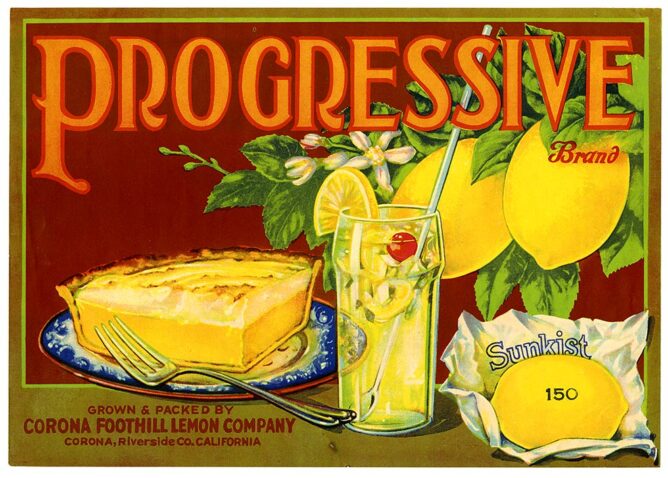
banner photo: Lemon crate label, Progressive Brand, Lehmann Printing and Lithographing Co. (on flickr)